EarthCARE maps vast atmospheric dust trails
Leipzig,
16.03.2026
– Moritz Haarig / Holger Baars
first global seasonal aerosol statistics based on EarthCARE
Aerosol particles are widespread throughout Earth’s atmosphere. They are emitted by deserts, oceans, volcanoes, wildfires and plants, or produced through anthropogenic processes such as combustion and agricultural activities.
EarthCARE, ESA’s Earth Cloud Aerosol and Radiation Explorer, gives us a new view of atmospheric aerosols, including their occurrence, composition and transport.
The most abundant type of aerosol is mineral dust.
Every year, several hundred million tonnes of material enter the atmosphere from the world's major deserts. These mineral particles affect the Earth’s radiation balance, interact with clouds and precipitation, and provide nutrients for oceanic and terrestrial ecosystems.
EarthCARE’s key instrument for aerosols is the high-spectral-resolution atmospheric lidar (ATLID), which measures characteristic aerosol optical properties at 355 nm wavelength. It enables us to distinguish between different types of particles such as dust, sea salt, pollution and smoke or mixtures of them – height-resolved from Earth’s surface up to 30 km.
“After one and a half years of EarthCARE observations, we have produced the first global aerosol statistics based on seasonal averages,” says Holger Baars of the Leibniz Institute for Tropospheric Research (TROPOS). “It is the first time that particle depolarisation and lidar ratio in the UV can be directly measured from space with high vertical resolution.”
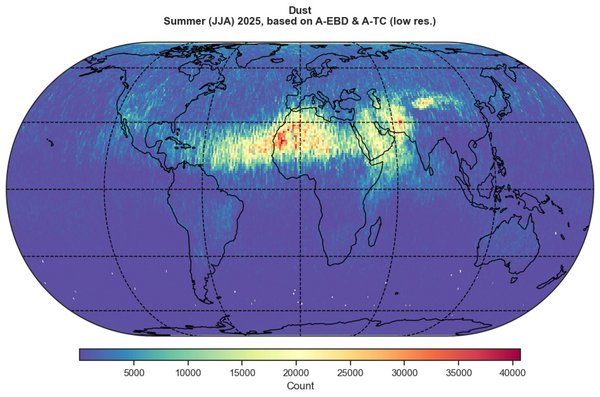
The first image shows the global distribution of mineral dust measured with ATLID in the summer of 2025. We can clearly see the northern hemispheric dust belt, with its major source regions in the Sahara, the Arabian Peninsula and West and Central Asia.
The map also reveals typical transport patterns. From the Sahara, the pathway is across the Atlantic to the Caribbean, while Asian dust is blown southwards and eastwards into the Indian Ocean and East Asia.
EarthCARE shows the distribution of mineral dust in the atmosphere
Global distribution of mineral dust measured with EarthCARE’s high-spectral-resolution atmospheric lidar (ATLID) from June to August 2025 based on the EarthCARE products ATL_EBD_2A and ATL_TC__2A.
ATLID detects the presence of aerosol with a resolution of about 1 km horizontally and 100 m vertically. For the global map, all data points that had been classified as dust were counted and allocated to 1° × 1° latitude-longitude grid boxes over the observation period of June to August 2025. The colours indicate the number of data points classified as dust in 1° × 1° latitude-longitude grid boxes.
Credit: Leonard König, TROPOS.
Two characteristic dust optical properties can be observed with ATLID – the particle depolarisation and the lidar ratio. Depolarisation is a measure of particle shape. Large, nonspherical dust particles strongly depolarise ATLID’s linearly polarised laser light when it is scattered back to the instrument. In contrast, the polarisation state is preserved when the laser light is scattered by small droplets, as they occur in sea spray or industrial haze. In this way, mineral dust can be clearly distinguished from other aerosol types.
The lidar ratio, or extinction-to-backscatter ratio, describes the relationship between the amount of light that gets lost by scattering and absorption when passing through an aerosol layer and the amount of light that is backscattered to the instrument. Therefore, the lidar ratio is a measure of particle absorption properties, although particle size and shape also play a role in this parameter.
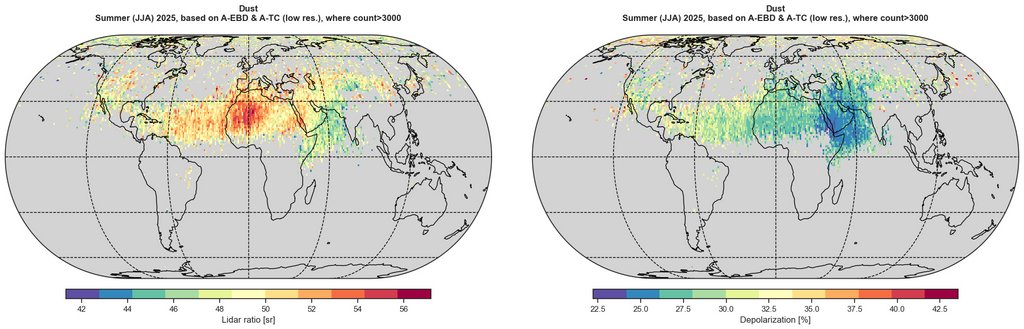
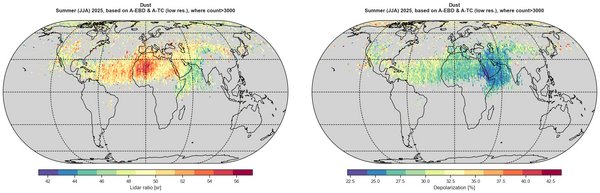
The optical properties of mineral dust vary depending on the source region and change during transport. In the second image, the lidar ratio is much higher over the Western Sahara than over Asia, while depolarisation is relatively low over the Arabian Peninsula compared to other regions. Such findings hint towards different mineralogical composition, changes in particle size and shape, or even contamination of the dust with other air pollutants.
EarthCARE unveils the regional dependence of dust optical properties
Global distribution of dust optical properties measured with ATLID in the summer of 2025, based on the EarthCARE products ATL_EBD_2A and ATL_TC__2A. ATLID detects the presence of aerosol with a resolution of about 1 km horizontally and 100 m vertically. The colours show the mean depolarisation (left) and lidar ratio (right) at 355 nm for all 1° × 1° latitude-longitude grid boxes that contain more than 3000 dust data points.
Credit: Leonard König, TROPOS.
“ATLID’s new observing capabilities allow us to precisely type aerosols from space and investigate the range of properties that mineral dust can have,” adds Moritz Haarig from TROPOS.
“These observations provide a clearer picture of the relationship between regionally varying dust mineralogy and its optical properties, which are crucial for assessing the impact of dust on the Earth’s radiation budget.”
With its unique observations of aerosol and cloud profiles, and how they trap and reflect radiation, EarthCARE aims to improve numerical weather models and predictions about the future climate.
“The first global maps of depolarization and lidar ratio observed with EarthCARE are a significant step forward for us,” says Holger Baars.
“The maps will help us to gain new insights into the optical and microphysical properties of dust. This will also boost our understanding of complex aerosol-cloud interactions and reduce one of the major sources of uncertainty in future-climate predictions.”
The ATLID team of the EarthCARE Data, Innovation and Science Cluster (DISC), from the Leibniz Institute of Tropospheric Research (TROPOS)
ESA picture of the day:
https://earth.esa.int/eogateway/gallery/earthcare-shows-the-distribution-of-mineral-dust-in-the-atmosphere
EarthCARE maps vast atmospheric dust trails, ESA, 11 Mar 2026
https://earth.esa.int/eogateway/success-story/earthcare-maps-vast-atmospheric-dust-trails
EartCARE mission:
https://earth.esa.int/eogateway/missions/earthcare