‘London fog’ causes poor air quality
Radeburg, 09.02.2026 – Nabil Deabji/ Hartmut Herrmann/ Jens Vogtländer/ Tilo Arnhold
TROPOS researchers have also recorded unusually high levels of particulate matter in rural Saxony in recent days.
An intensive measurement campaign has been running in Radeburg near Dresden over the last two weeks. Researchers from TROPOS are spending two years there investigating the impact of wood-burning heating systems on air quality on behalf of the Saxon State Office for Environment, Agriculture and Geology (LfULG). The levels measured in Radeburg last week are remarkably high and exceed the particulate matter levels observed at this location in recent months:
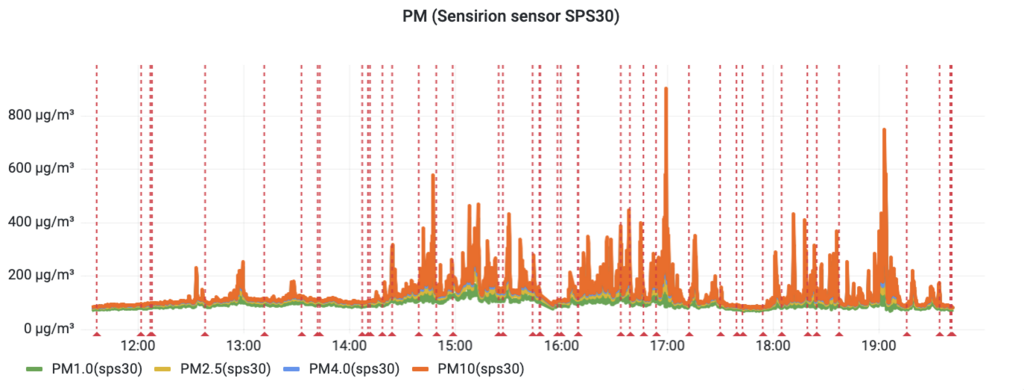
PM10 concentrations reached up to 80 µg/m3 (micrograms per cubic metre), while soot content exceeded 6 µg/m3. At the same time, the Aerosol Chemical Speciation Monitor (ACSM), a special mass spectrometer, shows organic peak values for PM1 above 30 µg/m3 – “strongly consistent with emissions from residential wood burning”. "These are unusually high pollutant concentrations for German conditions, levels comparable to severe winter pollution episodes reported in highly polluted regions worldwide, for example, where 100 µg/m3 is not uncommon. We can see this just by looking at the filters, which are dark brown instead of the usual light grey," reports Dr Nabil Deabji, who has been supervising the measurements in Radeburg since the beginning. ‘We were particularly surprised that such high concentrations occurred despite high relative humidity and even precipitation, as precipitation normally removes fine particulate matter from the air. In addition, persistent atmospheric stagnation with very limited vertical air mixing likely contributed to elevated near-surface pollutant levels. This situation was further reinforced by the virtually absent wind in recent days, which strongly limited dispersion.’
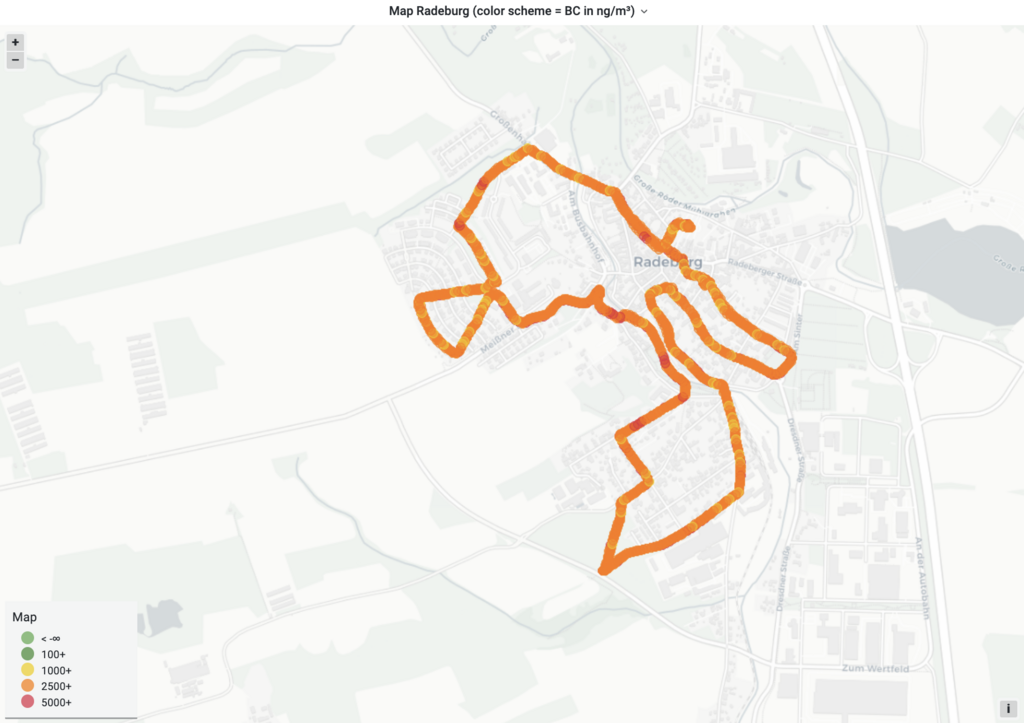
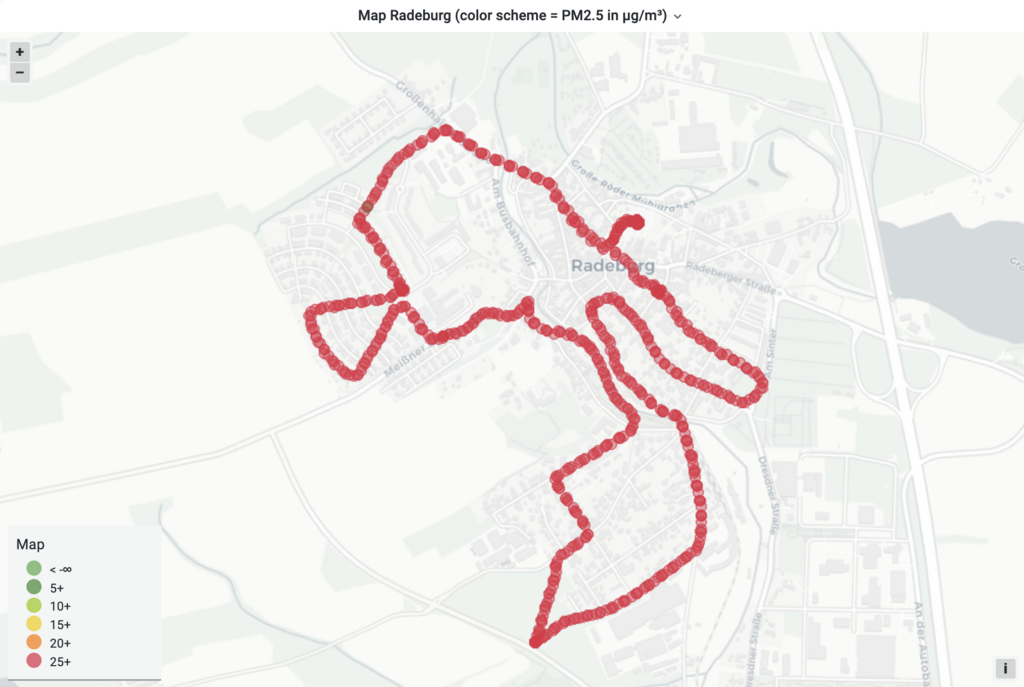
The situation was particularly drastic on Thursday (5 February 2026): "While we usually see significant peaks in the morning and evening and a decline in between, on this day the concentration remained consistently high and hardly fell below 100 micrograms per cubic metre in our mobile PM2.5 measurements. That is four times the daily limit value. Soot concentrations were also very high throughout the day, ranging from 2.5 to 5 micrograms per cubic metre across the entire study area. This suggests that the fog absorbed the pollutants from heating systems and traffic and held them over the town," explains Dr Jens Vogtländer from TROPOS, who walked through Radeburg on a fixed route with a measuring backpack to supplement the point measurements taken by the station at the market square with mobile measurements around the town. ‘In the end, I spent a total of 12 days in Radeburg for the mobile measurements (6 measurement days in February 2025 and 2026), during which time I walked the same 7.5 km route around 50 times, spending around 100 hours on foot on the streets of Radeburg.’ That adds up to a distance of over 375 km – a total of 9 marathons or one and a half half marathons on each of the days he was out, during which Vogtländer got to know Radeburg and also got into conversation with the people of Radeburg.
In addition to online measurements using the mobile backpack and various stationary high-tech devices, the team also collected filter samples at three locations, the chemical composition of which will now be analysed in detail. Once the extensive data has been scientifically evaluated, LfULG and TROPOS intend to inform local residents about the results of the project at a public event in the town hall next winter.
On Friday, the Saxon State Office for Environment, Agriculture and Geology (LfULG) had already reported that the daily limit values of 50 micrograms per cubic metre of air had been exceeded in five Saxon cities (Bautzen, Dresden, Görlitz, Leipzig and Niesky). The highest PM10 concentration was in Leipzig-Mitte, at 93 micrograms per cubic metre. ( https://social.sachsen.de/@lfulg/116018223876103382 > https://www.umwelt.sachsen.de/umwelt/infosysteme/luftonline/Bulletin.aspx?tag=06&mon=02&jhr=2026 ) Since 2005, this daily limit value may be exceeded on no more than 35 days in a calendar year. From 2030, this daily limit value is to be reduced to 45 micrograms per cubic metre and may be exceeded on no more than 18 days in a calendar year. ( https://eur-lex.europa.eu/legal-content/DE/TXT/HTML/?uri=OJ:L_202402881#anx_I )
At the Air & Climate Status Colloquium in October, the LfULG pointed out that although all valid limit values are currently still being complied with, the weather conditions in the first half of 2025 meant that air quality in Saxony declined significantly compared to the previous years 2023 and 2024: "In particular, PM10 and PM2.5 particulate matter concentrations were significantly higher at all Saxony air monitoring stations than in the comparable period of the two previous years. This is mainly due to the so-called low air exchange inversion weather conditions in February and March. ... If the meteorological conditions in 2026 were comparable to those in 2025, air pollution control plans would have to be drawn up for a number of Saxon cities and districts." ( https://medienservice.sachsen.de/medien/news/1090988 )
"The high particulate matter levels of recent days show that we have still not (and may not be for a long time) achieved the ideal situation. Even though much has been achieved through the measures taken in recent years, there is still a lot to do, because clean air is just as essential to our health as clean water," emphasises Prof. Hartmut Herrmann from TROPOS, who coordinates the project in Radeburg and has been in charge of the TROPOS measuring station in Melpitz near Torgau since the 1990s.