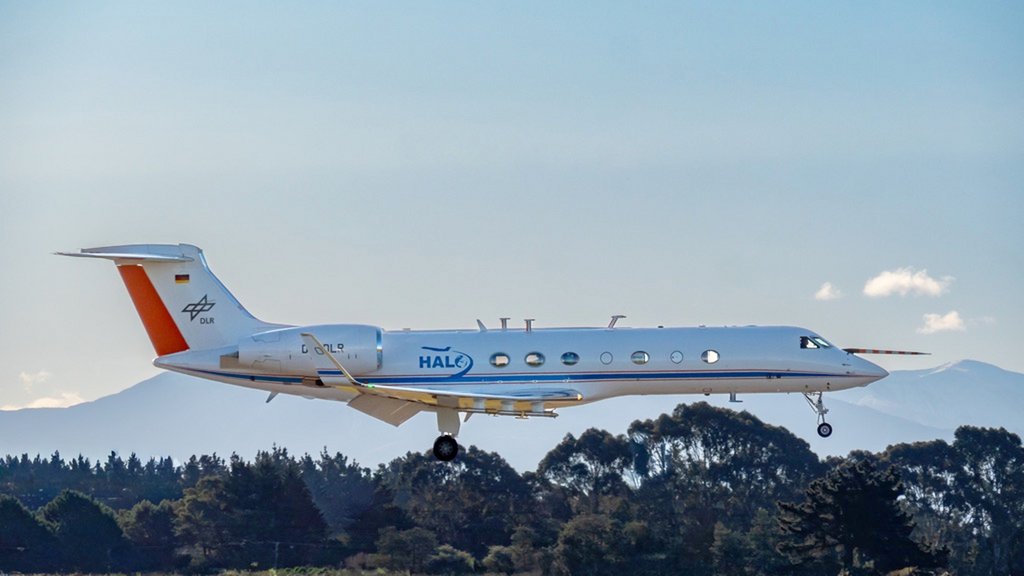
HALO South - The interplay of Clouds, Aerosols and Radiation above the Southern Ocean
Leipzig,
14.05.2026
– Baseerat Romshoo & Peter Edward Lloyd
A look back at the mission of the German research aircraft in New Zealand and the Southern Ocean
To understand the microphysical processes in earth’s atmosphere, we would need a controlled environment for measurements – in other words: laboratory conditions. However earth’s atmosphere can not be simulated in a laboratory in all its complexity. The next best solution is taking measurements in a place on earth, which comes close to such laboratory conditions. An example for such a region is the Southern Ocean. This region is particularly interesting for a second reason: Atmospheric models have large biases regarding aerosol, clouds and radiative transfer in the Southern Ocean. Fixing these biases by understanding the atmospheric processes in the Southern Ocean is incredibly important for models on a global scale.
The Southern Ocean is the ocean surrounding the Antarctic continent. It is characterized by the annual cycle of Antarctic sea ice and is an exceptionally windy and cloudy region of earth. Above all, this region is largely untouched by humans and the atmosphere is pristine, which means it is not polluted by human-emitted aerosol particles and short-lived chemical compounds. This is makes the Southern Ocean close to a perfect laboratory for atmospheric research.
But what are the processes we want to observe there? We are interested in the microscopic interactions between aerosol particles, cloud water and radiation. Locally they govern the formation of clouds and precipitation and on a global scale they influence earth’s radiative balance and climate.
To obtain measurements of aerosols, cloud particles and radiation, the German High Altitude Long Range research aircraft (HALO) was used like a „flying laboratory“. During research flights measurements were taken directly from the surrounding atmosphere. Twenty such research flights were conducted during the HALO South campaign from Christchurch, New Zealand in September and October of 2025 in the region around New Zealand and deep into the Southern Ocean.
In this article we want to highlight some of the main strenghts of the HALO South campaign.
Diversity
The twenty targeted research flights probed the atmosphere under a variety of different meteorological conditions.
Nine of the research flights were conducted to sample pristine air masses (not influenced by human activity). Four of these flights also included Antarctic sea ice overpasses as far as 66° South covering regions of different ice cover and ice thickness. These measurements of pristine air masses helped to constrain the natural background state of Southern Ocean clouds.
Three flights were designed to sample „dirty“ or aerosol-loaded air from the Australian continent. In such cases distinct pollution layers, and dust- and soot-affected conditions over the ocean could be observed, which was especially important to understand how continental emissions modify marine clouds.
Four flights were focused on transported Antarctic air masses and sampling in and around cyclones. Such flights allowed the team to observe how aerosol and cloud properties evolved along air-mass trajectories.
Four flights had special targets such as an atmospheric river (a large flux of moisture reaching from the tropics into the mid latitudes), biological tracers near the Chatham Islands or transported sulfate.
In other words, the campaign was designed not around only one type of Southern Ocean atmosphere, but around a very broad spectrum of conditions, ranging from exceptionally clean Antarctic air to cases that were influenced by dust, soot, biological material and volcanic plumes.
Case studies
The campaign also included especially interesting chemical and biological cases. One flight sampled a clean Southern Ocean air mass in a region of high biological activity around the Chatham Islands, while another flight investigated an air mass originating from Antarctica with enhanced sulfate concentrations and possible influence from the volcano Mount Erebus. These flights highlighted the importance of these distinct chemical signatures that may affect cloud formation.
Vertical Soundings
Another core feature of HALO-South were vertical soundings. In total 46 dropsondes were successfully released during interesting meteorological conditions: sixteen in a cyclone case, six during one Antarctic sea-ice mission, six during a marginal ice-zone cold-air-outbreak case, and eighteen in the atmospheric-river flight. These dropsondes provided detailed measurements of temperature, humidity, and wind structure and were additionally used to assimilate the ECMWF model.
EarthCARE coordination
A further strength of the campaign was its coordination with satellite observations of the satellite EarthCARE. Eight flights were cunducted with EarthCARE overpasses or close EarthCARE coordination, including pristine, sea-ice, cyclone, dirty, and special-case flights. This provides great data to validate satellite measurements with the measurements of the HALO South campaign.
International scientific outreach
Beyond the science, HALO South also became a visible platform for outreach and international collaboration. During the Gateway to Antarctica season opening in Ōtautahi Christchurch, the German Ambassador and other dignitaries joined local partners to officially welcome and celebrate the HALO South mission. The event highlighted the campaign as a strong example of scientific partnership between Germany and New Zealand, “Aotearoa”. The HALO research aircraft was presented not simply as an aircraft, but as a highly advanced airborne laboratory that brought together German and New Zealand scientists to better understand the Earth system and climate. At the event, Christchurch’s Mayor Phil Mauger described HALO South as “an outstanding example of science cooperation,” while Professor Lucy Johnston, Deputy Vice-Chancellor Research & Innovation at the University of Canterbury, emphasized the importance of such partnerships for Antarctic science.
Overall, under the leadership of Prof. Mira Pöhlker, HALO-South combined ambitious atmospheric science with a remarkably broad observational design. The campaign generated a uniquely rich dataset for Southern Ocean aerosol–cloud–climate research. At the same time, it also demonstrated how international field campaigns could connect institutions, countries, and communities around a shared scientific goal. We are looking forward to the next phase of this exciting mission and to the insights it will bring.
Baseerat Romshoo & Peter Edward Lloyd
Links:
Mission description:
https://halo-research.de/science/halo-missions/current-missions/halo-south/
Projektbeschreibung:
https://www.tropos.de/institut/abteilungen/experimentelle-aerosol-und-wolkenmikrophysik/aerosol-wolken-wechselwirkungen/halo-south
HALO-South at Instragram
https://www.instagram.com/halo_south25/
HALO-South at LinkedIn:
https://www.linkedin.com/company/halo-south-2025/