Atmospheric chemistry is a rapidly evolving field driven by the need to understand the complex processes that affect air quality and climate. Key research areas include multiphase chemistry, in which interactions among gases, liquids, and particles govern the transformation of pollutants. Advanced laboratory and field studies continue to uncover new reaction pathways and mechanisms. These activities represent emerging research directions with strong potential to inform future strategies in environmental protection and climate mitigation.
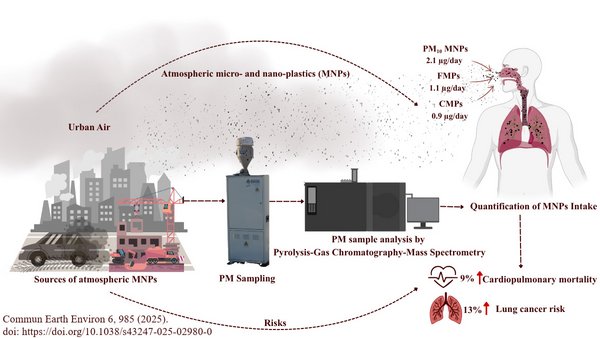
Composition, Interactions, and Inhalation Risks of Micro- and Nano-Plastics in Urban Air
Airborne micro- and nano-plastics (MNPs) are increasingly recognized as a significant component of urban particulate matter. This study demonstrates their widespread presence in urban air, with tire wear particles identified as a dominant source. Smaller particles, enriched with potentially hazardous polymers, pose a higher inhalation risk due to their ability to penetrate deeply into the respiratory system.
Estimates of daily and annual human exposure underline potential public health implications, including increased risks of cardiopulmonary diseases and lung cancer. These findings highlight the urgent need for regulatory frameworks, standardized monitoring approaches, and the integration of MNPs into air quality assessment and policy. However, further long-term studies are required to better understand exposure-response relationships, establish safe thresholds, and refine risk assessment methodologies.
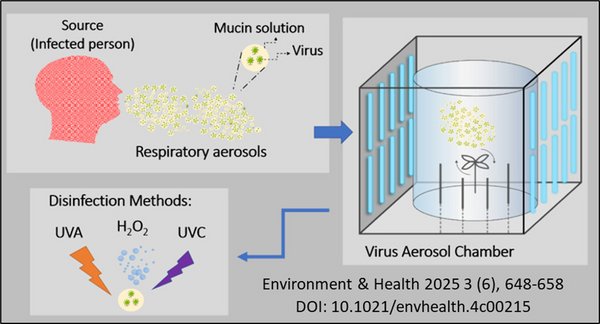
Virus Aerosol Chamber Study: Effects of UVA, UVC, and Hydrogen Peroxide on Airborne Viral Transmission
This study investigates strategies to reduce airborne viral transmission under controlled indoor-like conditions. The results show that viruses embedded in mucus-like particles exhibit greater resistance to UV radiation than previously assumed, limiting the effectiveness of UV-based disinfection alone. Hydrogen peroxide (H₂O₂) demonstrates significant antiviral activity, even in the absence of light. Most notably, the combined application of UV radiation and hydrogen peroxide leads to a substantial enhancement in virus inactivation, indicating strong synergistic effects.
These findings suggest that integrated chemical and photochemical approaches could provide more effective solutions for mitigating airborne virus transmission in indoor environments. Nevertheless, further studies involving real pathogenic viruses are necessary to validate these results and support practical implementation.