
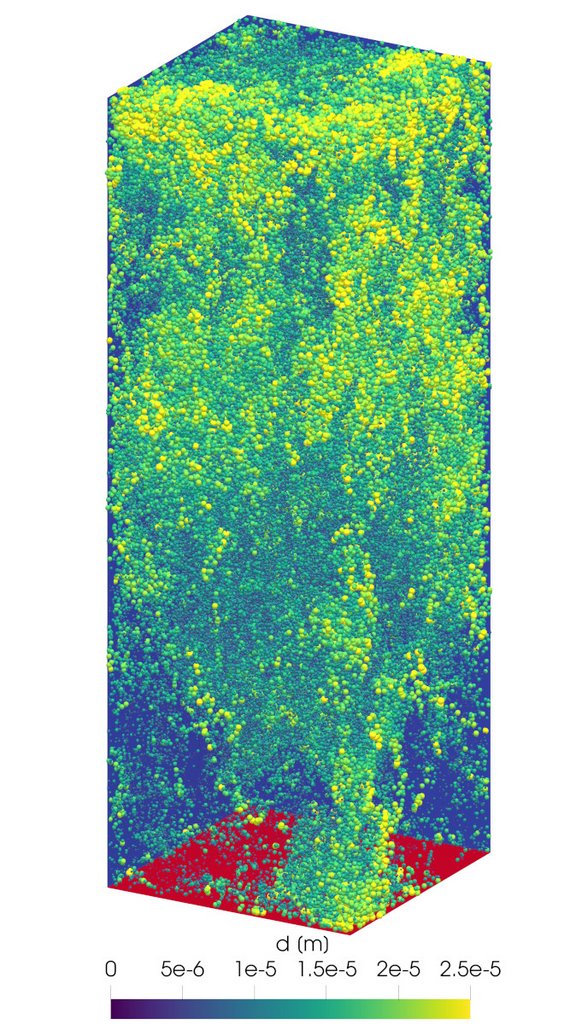
Snapshot of a simulation with SCALE-TRACK. Shown is a cloud chamber with drops of varying sizes (not to scale).
Disperse multiphase flows are ubiquitous in natural processes, such as clouds, as well as in technical applications. The Euler-Lagrange method (EL) is a numerical approach for modelling these flows. Here, the continuous phase is calculated in an Eulerian grid, while the disperse phase is treated using a Lagrangian approach. Two-way coupling, in which both phases interact with each other, is crucial for the accurate simulation of systems such as clouds or other disperse flows. Despite its simplicity, the EL method is computationally intensive. Modern heterogeneous high-performance computers with CPU-GPU combinations have not been optimally utilised for EL simulations to date due to challenges such as synchronisation barriers, load balancing and poor scalability. To solve these problems, the SCALE-TRACK (Scalable two-way coupled Euler-Lagrange particle tracking algorithm) algorithm was developed. It uses asynchronous coupling, chunk-based partitioning and cache-friendly data structures to enable efficient EL simulations on exascale systems. Excellent strong and weak scaling was demonstrated on a high-performance computing cluster with up to 256×109 particles on 256 GPUs.
This project has received funding from the European High-Performance Computing Joint Undertaking (EuroHPC JU) under grant agreement No 101118139. The JU receives support from the European Union’s Horizon Europe Programme.