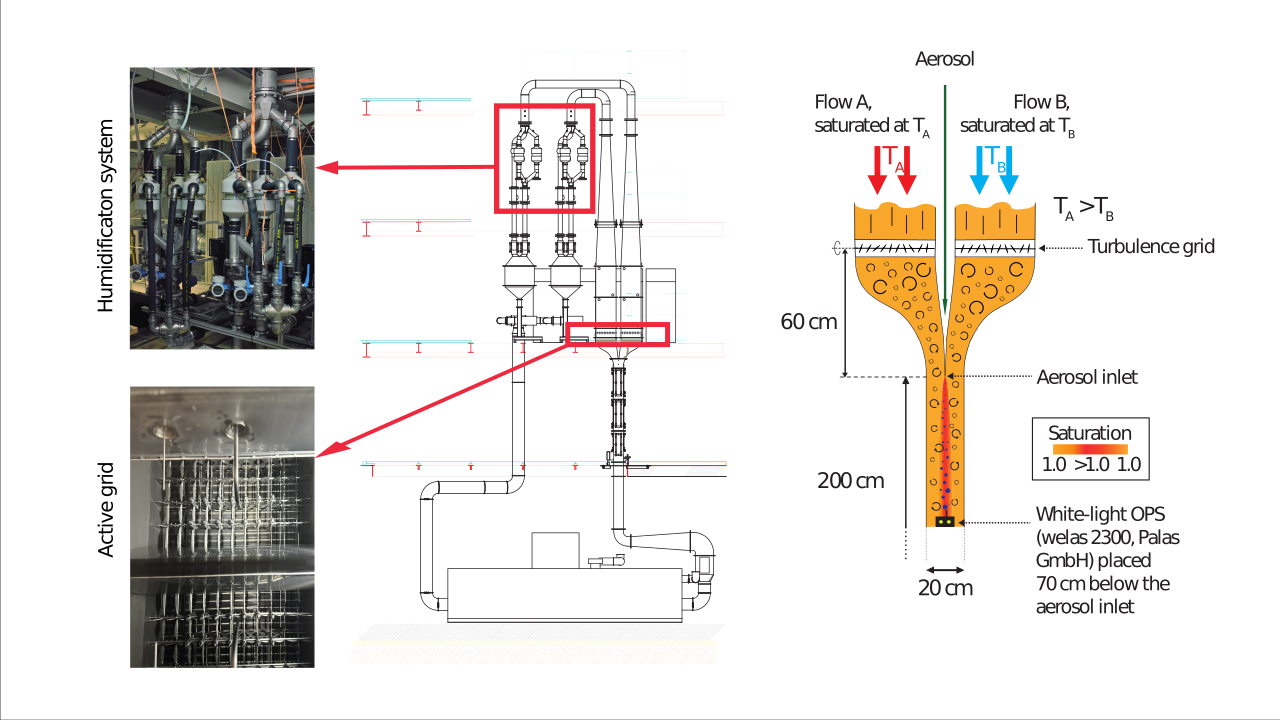
Fig. 1: Schematic illustration of LACIS-T showing its individual components and the operating principle of LACIS-T for isobaric mixing (© Ingenieurbüro Mathias Lippold, VDI; TROPOS).

Investigating the influences of TURbulence on dynamic dropleT growth under variabLE saturation conditions (TURtle)
Atmospheric clouds are highly dynamic and heterogeneous, with turbulence and droplet microphysics interacting with each other on many spatial and temporal scales. This interaction can have a fundamental impact on cloud development and the shape of droplet size distributions.
The goal of the project TURtle is to develop a quantitative understanding of how turbulence-induced changes in water vapour saturation affect droplet growth and variability within droplet populations. These effects are particularly important in environments that transition from predominantly unsaturated to nearly saturated or supersaturated conditions. In such environments, droplets do not simply equilibrate to a single mean state: they experience fluctuating conditions while their growth proceeds with specific response rates, which can lead to modified (e.g., broadened and/or shifted) size distributions compared to idealized steady conditions.
The experimental basis of TURtle is LACIS-T (Turbulent Leipzig Aerosol Cloud Interaction Simulator), a turbulent moist-air wind tunnel at TROPOS. LACIS-T allows for the systematic control over key parameters such as aerosol particle composition, number and dry size (e.g., size-selected, monodisperse NaCl particles), saturation conditions (mean and width), and turbulence intensity. This enables systematic mapping of regimes from quasi-equilibrium to clearly non-equilibrium droplet growth under well-defined and reproducible conditions.
Fig. 1: Schematic illustration of LACIS-T showing its individual components and the operating principle of LACIS-T for isobaric mixing (© Ingenieurbüro Mathias Lippold, VDI; TROPOS).
The laboratory studies are complemented by computational fluid dynamics simulations which help us to design the experiments as well as to interpret the experimental results. The simulations are performed in OpenFOAM® for modeling flow, heat and mass transfer as well as particle and droplet dynamics. We formulated a Eulerian– Lagrangian approach so that the growth of individual cloud particles can be tracked along their trajectories through the simulation domain.
We focus on the droplet size distributions (DSD). Due to turbulence, we obtain saturation fluctuations so that individual droplets encounter different local saturations and consequently grow differently. This influences the shape of the DSD leading to a broadening as illustrated schematically below. Quantifying this broadening — and its dependence on turbulence intensity and humidity condition — is a central goal of TURtle.
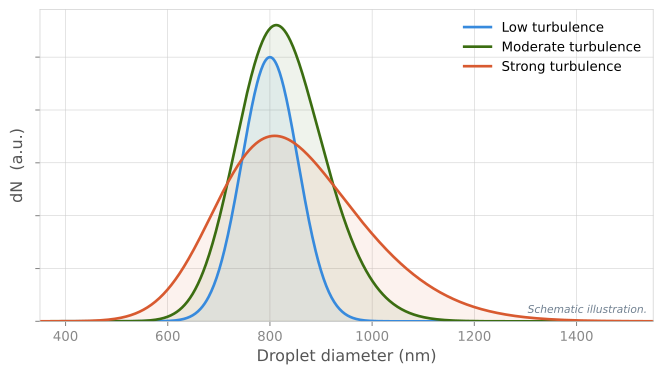
Fig. 2: Schematic illustration of the effect of turbulence on the droplet size distribution.