AC3-B04
The AC³-B04 project, a part of the Transregional Collaborative Research Centre TR 172 (AC)³ - focuses on the spatial distribution, sources, and cloud processing of aerosol particles in the Arctic, with a particular emphasis on cloud condensation nuclei (CCN), ice-nucleating particles (INP), and black carbon (BC). These particle types play a key role in the formation, phase state, and properties of Arctic clouds and thus influence the radiation balance and Arctic amplification – a phenomenon in which temperatures in the Arctic warm more strongly than the global average. Previous project phases have already shown that the concentrations, properties, and sources of these particles vary strongly, that seasonal patterns exist, and that potential marine sources such as marine polysaccharides may play a role. At the same time, the interplay between particle sources, turbulent transport processes, and cloud formation remains insufficiently understood, which complicates the interpretation of measurement data and their representation in climate models.
To address these gaps, AC³-B04 combines ground-based, airborne, and laboratory studies: Using the newly developed towed-body “T-Bird” (Jurányi et al., 2025) and the Polar 6 research aircraft (Wesche et al., 2016), coupled measurements of aerosol concentrations and turbulent fluxes are carried out for the first time during the BACSAM I and II measurement campaigns (“Boundary layer and Atmospheric Aerosol- and Cloud Study in the Arctic”), from the surface through the marine boundary layer up to the free troposphere. Complementary laboratory experiments simultaneously investigate the transfer of INP tracers such as marine polysaccharides from the ocean surface into the atmosphere. The findings are incorporated into parametric descriptions and model schemes to improve the representation of aerosol-cloud interactions in regional and global models and thus contribute to understanding Arctic amplification.
BACSAM
The BACSAM I and II measurement campaigns, conducted in October 2022 and April 2024, focus on investigating the interactions between aerosols, clouds, and turbulent processes in the Arctic boundary layer and free troposphere in order to improve the understanding of aerosol-cloud-climate interactions in the Arctic. Within the framework of these two flight campaigns, simultaneous measurements of aerosol and turbulence properties were carried out using the Polar 6 research aircraft and the newly developed towed instrument platform T-Bird, from a few meters above the surface up to the upper boundary layer and the free troposphere (Jurányi et al., 2025).
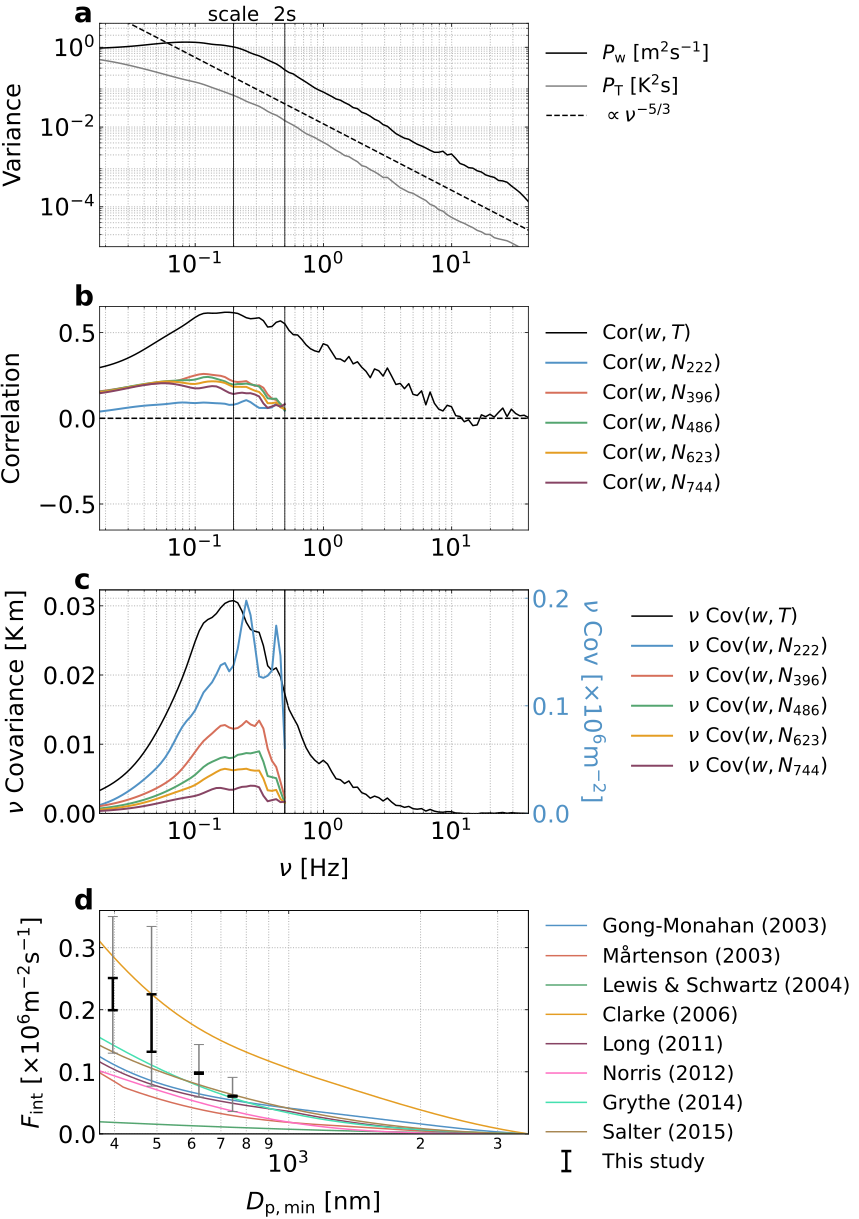
The data obtained help to quantify in greater detail the role of aerosol-cloud-turbulence interactions in the Arctic climate system and to better understand the processes that influence aerosols as cloud condensation nuclei (CCN) and ice-nucleating particles (INP). By combining high-resolution measurements of the atmospheric boundary layer with simultaneously recorded turbulence parameters, BACSAM provides new insights into the coupling between particles, meteorological fluxes, and cloud processes in one of the most sensitive regions of the climate system. In a pioneering study, size-resolved particle fluxes were quantified for the first time from an airborne measurement platform using the T-Bird (Simon et al., 2025).
The results not only support process-level analysis but also provide important reference data for improving parametric descriptions in regional and global climate models. Among other findings, the measurements indicate that many sea salt emission parameterizations commonly used in climate models considerably underestimate the actual transport of particles from the open ocean into the atmosphere (Simon et al., 2025, Fig. 1).