ACROSS Project (Atmospheric Chemistry of the Suburban Forest)
Urban air pollution results from complex interactions between anthropogenic emissions and natural biogenic compounds. The problem became particularly apparent as people moved into large cities, where high population densities exacerbated pollution from home heating and industry. The ACROSS project investigates the detailed chemistry and physics of these mixed-emission sources to improve air-quality modelling and understanding of atmospheric processes.
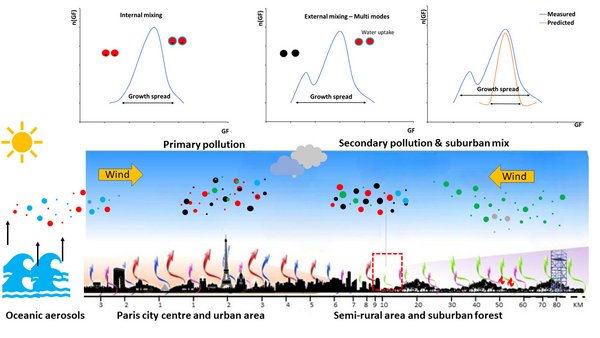
Within this campaign, TROPOS contributed advanced HTDMA measurements to examine how aerosol hygroscopicity evolves in a suburban environment influenced by both urban emissions and biogenic precursors (Fig. 1). Aerosol particles undergo continuous physicochemical transformations during their atmospheric lifetime, altering their water-uptake behaviour and cloud-activation potential. By providing time-resolved and size-resolved hygroscopic measurements, the campaign enabled the evaluation of aerosol ageing processes and mixing-state variability.
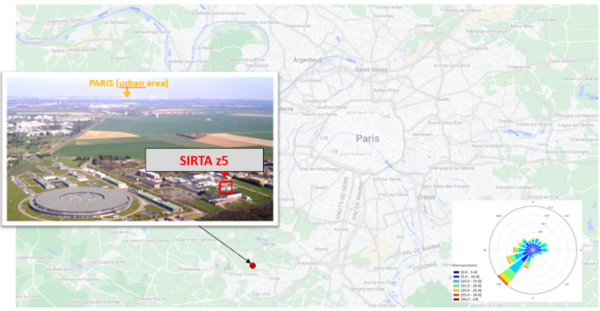
Measurements were conducted at the SIRTA atmospheric observatory near Paris (Fig. 2), a region strongly influenced by urban outflow and regional atmospheric transport. The study investigated particles in the 100–250 nm size range, providing insights into hygroscopic growth and dynamics of aerosol mixing state. Variability in hygroscopic growth factor distributions and their standard deviation allowed quantification of aerosol mixing state, distinguishing externally mixed particle populations from internally mixed aerosols (Deshmukh et al., 2025). The standard deviation or sigma (s) of the growth factor derived from the HTDMA can explain the degree of mixing of particles and the growth spread (Sjogren et al., 2008; Spitieri et al., 2023).
Scientific outcomes:
Improved understanding of aerosol ageing in suburban atmospheric environments
Quantification of aerosol mixing state variability under real atmospheric conditions
Provision of observational constraints for regional air-quality and climate models