Chamber-BIODUST Project – Biomass Burning and Dust Interaction
The increasing frequency and intensity of wildfire events highlight the importance of understanding the atmospheric effects of biomass burning emissions. Smoke plumes frequently contain mixtures of combustion aerosols and mineral dust particles, yet their combined microphysical and chemical behaviour remains poorly characterised.
The BIODUST chamber experiments investigate interactions between biomass burning aerosols and mineral dust particles under controlled laboratory conditions. These mixtures influence aerosol radiative properties, secondary organic aerosol formation, and cloud nucleation behaviour. Dust particles can act as reactive surfaces and condensation sites, altering aerosol ageing pathways and atmospheric lifetime.
TROPOS provides a unique research environment for this work through the integration of experimental facilities, including the Leibniz Biomass Burning Facility (LBBF) and the Atmospheric Chemistry Department chamber. Combined measurements of particle hygroscopic growth, chemical composition, and CCN activity enable detailed analysis of aerosol transformation processes.
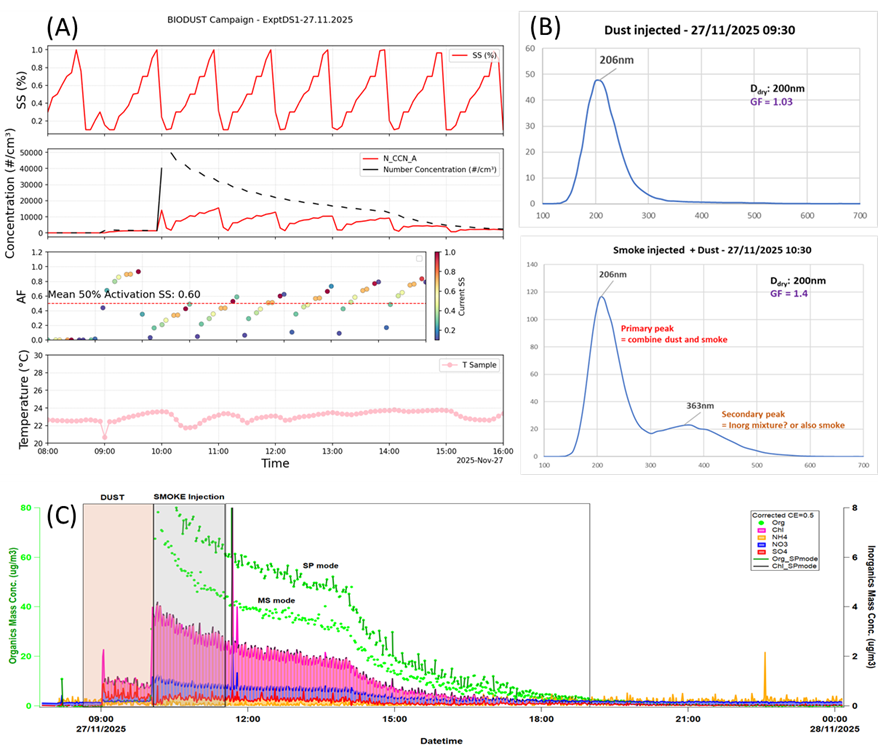
Preliminary findings demonstrate that smoke–dust interactions significantly modify hygroscopic growth behaviour and chemical composition, indicating complex mixing processes and externally mixed particle populations. Current climate models often neglect mineral dust emissions from wildfire events, suggesting that these results may help reduce uncertainties in aerosol–climate interactions. Some preliminary results are shown in Fig. 1.
Scientific outcomes:
- Identification of physicochemical transformation processes in smoke–dust mixtures
- Quantification of wildfire contributions to mineral dust aerosol emissions
- Improved representation of wildfire aerosol impacts in atmospheric chemistry and climate models