
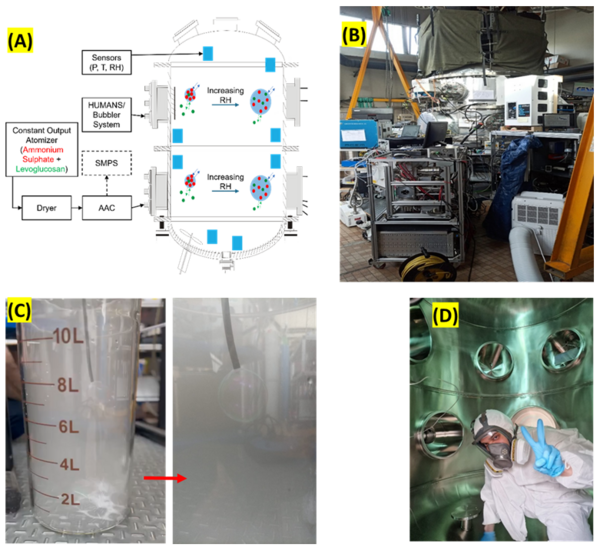
Figure 1: Detailed schematic of the experimental setup of the CESAM chamber and the instrumentation used for measurements during the ORACLE campaign (A). The abbreviations stand for: Aerosol Aerodynamic Classifier (AAC), Scanning Mobility Particle Sizer (Wet SMPS) for determining the wet particle diameter, and Mobility Particle Size Spectrometer (MPSS, referred to as dry SMPS) for determining the dry diameter. Blue rectangles indicate the positions of sensors measuring pressure (P), temperature (T), and relative humidity (RH). The relative humidity in the chamber is controlled by the HUMidificAtioN System (HUMANS). An Aerodyne HR-ToF-AMS continuously monitors the chemical composition of the particles. Inset from the campaign showing instrumentation connected to the CESAM chamber (B). Addition of SDS (sodium dodecyl sulfate) for surface tension experiments, visible through bubble formation in the vessel (C). Complete manual cleaning of the CESAM chamber, view into the interior of the chamber (D).