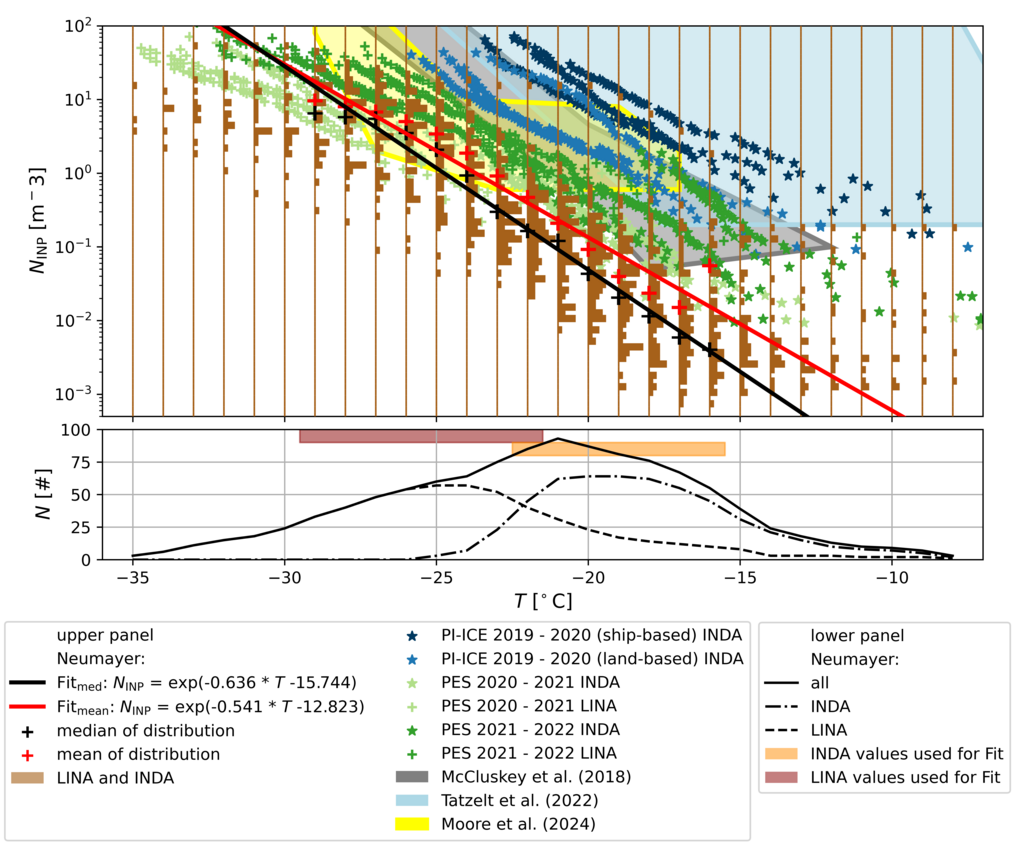
Objectives. Despite the progress polar climate research made, poorly understood processes remain, one of those being the aerosol – cloud – climate interaction, which still cannot be modelled with satisfying accuracy. Clouds and their interactions with the climate system are one of the most difficult components to model, especially in the polar regions. This is, among others, due to difficulties in obtaining high-quality measurements. The availability of high-quality measurements is therefore of crucial importance for understanding processes and for driving and / or evaluating atmospheric models. Increasing the available data-base is one of the main objectives of VACCINE. Starting with December 2019, TROPOS continuously performs in-situ Cloud Condensation Nuclei (CCN) and Ice Nucleating Particles (INP) measurements at Neumayer Station III. The captured data such as number concentrations, particle hygroscopicity, INP freezing spectra etc. were linked with meteorological information (e.g. back trajectories) and information on the chemical composition of the prevailing aerosol particles for identifying sources of INP and CCN (secondary vs. primary) and transport pathways (local vs. long-range transport) over the full annual cycle. A result of this project will be a deeper understanding about processes dominating the CCN and INP population in Antarctica.
Fieldwork. Starting with the austral summer season in December 2019, CCN-measurements are carried out at the AWI Air Chemistry Observatory with a commercially available CCN instrument (Roberts and Nenes 2005). With the instrument total CCN number concentrations can be determined as function of supersaturation in the range between 0.1 and about 1%. The CCN instrument has been measuring almost continuously since then and has been replaced with a freshly calibrated device beginning of the season 23/24 to prevent malfunction. However, in the current season 24/25 some hardware communication issues occurred, and the instrument needs to be replaced, but fortunately no data loss occurred. The daily / weekly on-site maintenance is being carried out by AWI-staff.
Besides CCN also INP sampling was established, using the low volume filter sampling setup available in the AWI Air Chemistry Observatory. These activities aim at the number concentrations of INP in the air, active at temperatures above -25°C. Filter samples are collected on polycarbonate filters and immediately frozen for later analysis in the TROPOS laboratories (Wex et al. 2019). The weekly filter change and handling is done by the AWI-staff, as well. The latest filter samples arrived recently at TROPOS and the analysis is ongoing.
CCN measurements. The CCN instrument measures CCN number concentrations at 5 different supersaturations. Combined with the particle number size distribution measurements, the particle hygroscopicity can be derived (Petters and Kreidenweis 2007). Running continuously since December 2019 more than five full years of CCN data for Neumayer station III have been gained. Number concentrations in general are low and a clear annual cycle is found for CCN as well as for the total particle number (CN). The latter is similar to results reported for the Belgian Princess Elisabeth Station, located 200 km inland in the escarpment zone of Dronning Maud Land at an altitude of 1400 m (Herenz et al. 2019). Lowest number concentrations are observed in austral winter months May to August and highest in austral summer.