
Vertical Turbulent Aerosol Particle Transport Above Open Water and Ice in the Central Arctic during Summertime (APAICA)
Aerosol particles are a central component of the Arctic climate system. Depending on their optical properties, their ice-nucleating potential, and their ability to form and modify Arctic clouds, they exert a strong influence on the radiation balance. It is therefore crucial to identify and quantify sources and sinks of Arctic aerosols—including vertical transport—and to characterize their optical properties and their role in cloud formation.
Despite their importance, there are still only few measurements of particle fluxes between the surface and the atmosphere over open water or sea ice in the central Arctic. Data on the physical and chemical properties of Arctic aerosols also remain limited. In this project, the focus is on turbulent particle fluxes as well as on black carbon (BC) and ice-nucleating particles (INPs) in the air and in ocean water.
A better understanding of Arctic aerosols and clouds—particularly mixed-phase clouds—is essential to better explain the pronounced warming in the Arctic, also known as Arctic amplification (Serreze and Barry, 2011). Aerosols and clouds are embedded in a complex network of interactions and feedbacks (Morrison et al., 2012), with the cold and mixed phases of these clouds playing a particularly important role. However, the sources and abundances of INPs are still insufficiently understood, making further detailed investigations necessary (Solomon et al., 2018).
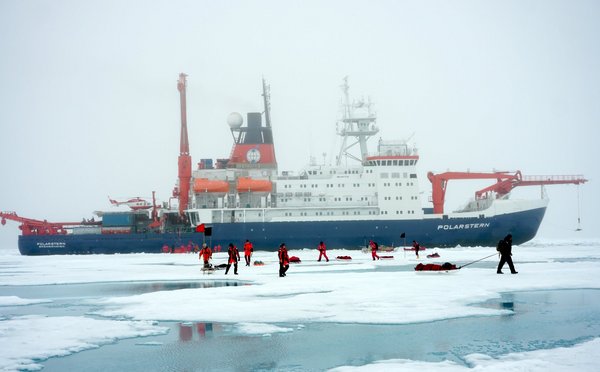
Within the framework of the Polarstern expedition PS131, we aim to contribute to the overarching research question “Coupling between ocean, sea ice, and atmosphere in the marginal ice zone (MIZ) and its influence on the ecosystem.” The following research questions are addressed:
- What are the magnitudes and directions of turbulent particle fluxes, and how do they vary depending on surface type and meteorological conditions?
- What are the respective contributions of (i) local emissions from the ocean and (ii) new particle formation (NPF) to the aerosol budget of the Arctic marine boundary layer, and which factors control these processes?
- What are the concentrations of black carbon in the air, in fog, and in the ocean?
- How are atmospheric and oceanic BC related, and what role does the mixing state play in deposition processes?
- What are the main sources of INPs in the Arctic marine boundary layer, and to what extent does the ocean contribute to the atmosphere?
For the expedition, a dedicated measurement system for aerosol flux observations was developed and successfully deployed—particularly system 1, which was installed on the bow boom. Regular quality control of the data showed good performance. Importantly, measurements could also be carried out while the ship was underway, allowing data to be collected under varying ice conditions. This enables valuable comparisons of particle fluxes over different surface types when additional information such as ice thickness or ice concentration is taken into account. Figure 2 provides an overview of the measurement locations over different surfaces. In total, 25 measurements with system 1 (marked in red) were conducted over ocean, melt ponds, and sea ice with varying concentrations. In addition, five vertical profile measurements of particle concentrations were performed.
Detailed data analysis will be carried out after the expedition at TROPOS and TU Berlin. Online measurements of refractory black carbon (rBC) and its mixing state using the SP2, together with complementary offline analyses of seawater and fog water samples, will provide insights into the transport pathways of BC particles in the Arctic MIZ. Previous studies suggest the existence of local marine sources of INPs, but their exact origin remains difficult to constrain. By analyzing seawater, aerosol, and fog water samples, the links between these compartments will be better understood and indications will be obtained as to whether the ocean represents a significant source of atmospheric INPs.
The parallel sampling of aerosols, fog and cloud water, and ocean water in combination with particle flux measurements provides a unique opportunity to improve our understanding of the interactions between the ocean, sea ice, and the atmosphere in the Arctic. With respect to BC-containing particles, little is currently known about their deposition into the ocean, and this study can also provide new insights in this regard.