

BIO-ICE
In atmospheric science, ice nucleating particles (INPs) are the catalysts required for water droplets to freeze at temperatures warmer than −38∘C. Laboratory studies have shown that among these, biological particles (bio-INPs) such as pollen, fungal spores, and bacteria and their components (proteins and sugars) are particularly efficient, triggering ice formation at temperatures as high as −2°C.
Despite their importance, there is a persistent "missing link" in field data: we often cannot quantitatively correlate the concentrations of primary biological aerosol particles (PBAPs) measured on the ground with the actual ice-nucleating activity observed in the atmosphere. This data gap means that current climate and weather models likely underestimate the influence of biology on precipitation and cloud lifetime.
The BIO-ICE project aims to bridge the gap between bioaerosol particle identification and ice-nucleation activity through a multi-scale sampling strategy:
- Temporal Scaling: We will conduct a 15-month long-term sampling program to capture seasonal variations (e.g., pollen seasons), supplemented by high-frequency "intensive" sampling periods to observe how biological particles respond to specific meteorological events like cold fronts or heavy rain.
- Bio-INP Analysis: Every sample will be analyzed to determine the specific fraction of ice nucleation caused by biological agents rather than mineral dust or soot.
A central component of this study is the characterization and deployment of the SwisensPoleno Jupiter (Swisens, Switzerland), a state-of-the-art bioaerosol monitor. This instrument characterizes individual particles in real-time using three simultaneous methods:
- Laser-Induced Fluorescence (LIF): To detect biological markers.
- Polarization: To determine particle shape
- Digital Holography: To provide imaging of the particle morphology.
To ensure the accuracy of the system’s AI-driven identification, we will validate the results against traditional "gold standard" methods: manual microscopic counting (Hirst-type traps) and multispectral imaging flow cytometry.
The meaurements are conducted at the ACTRIS station Melpitz, a rural background station ca. 40 km northeast of Leipzig.
By establishing a clearer relationship between specific biological species (like local wind-pollinated plants) and ice formation, this research will refine the parameterizations used in atmospheric models. Ultimately, this leads to more robust simulations of cloud microphysics, providing better accuracy for precipitation forecasts and long-term climate projections in the context of global warming.
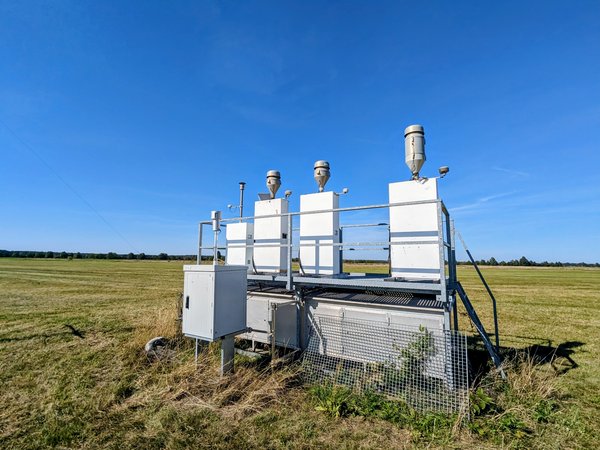
Measurement location at Melpitz. SwisensPoleno Jupiter (left on the ground) for the bioaerosol monitoring and the Digitel filter sampler (left on the platform) for the subsequent INP analysis.
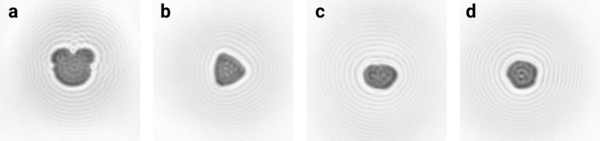
Holography images of pollen grains sampled in Melpitz belonging to the a) Pinaceae b) Corylus c) Alnus d) Betula families