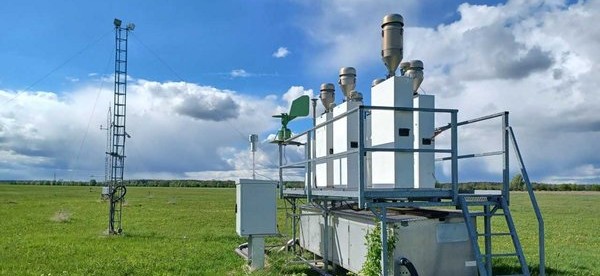
Measuring instruments for the detection and collection of biological aerosol particles at the TROPOS research station in Melpitz (Poleno on the left and Hirst pollen trap in green), set against the background of a raining cumulus congestus cloud.

"We explore the interactions between the biosphere and atmosphere, from molecular to global scale, to research how climate, clouds and human health are influenced by biogenic particles. Our research uncovers how biodiversity and ecosystem state regulate their emission and processing, advancing our understanding of Earth's interconnected systems."
Measuring instruments for the detection and collection of biological aerosol particles at the TROPOS research station in Melpitz (Poleno on the left and Hirst pollen trap in green), set against the background of a raining cumulus congestus cloud.
We investigate the impact of bioaerosols on the health of humans and ecosystems, studying the emission, transport, and properties of respiratory, pathogenic, and allergenic particles in indoor and outdoor environments.
Our research comprises an improved understanding and quantification of the roles of primary biological aerosol particles and secondary organic aerosols in cloud and precipitation formation. Therefore, a core part of our work is the detection and characterization of aerosol particles of biological origin: pollen, spores, bacteria, algae, and their components. We investigate the influence of different bioaerosols on ice formation, with a special focus on ice-nucleating macromolecules. As secondary organic aerosols influence the Earth's radiative budget, we analyze their contribution to ambient aerosols and their phase changes which they undergo when interacting with water.
As the biosphere faces increasing climatic extremes, we analyze its health status and its feedback effects on the atmosphere—essential for a holistic understanding of the Earth system.

The goal of BIO-ICE is to close the data gap between directly measured bioaerosol concentrations at the surface and ice-nucleating activity in the atmosphere, in order to improve weather and climate models that currently underestimate biological activity.
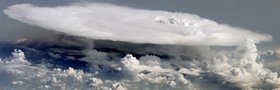
The goal of the CONTANGO-Fire mission is to improve the understanding of aerosol particle formation and evolution in the upper troposphere and their influence on cloud processes. Particular focus is placed on the role of deep convection, biogenic trace gases, and emissions from vegetation fires. This will be achieved through in situ measurements of aerosol size distributions, cloud condensation nuclei, and trace gases during a research aircraft campaign using the HALO aircraft.
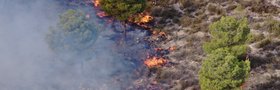
The LSC BioSmoke project focuses on researching feedbacks between wildfires, aerosol chemistry, and climate. One objective is to better classify and understand vegetation as a source of organic aerosols and smoke emissions.
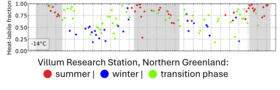
Ice-nucleating particles (INPs) which can already induce ice nucleation at high sub-zero temperatures are often biogenic by nature. In a number of measurement campaigns, among them long-term deployments, we examined the contribution of biogenic INPs to the atmospheric aerosol.
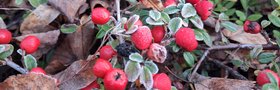
This project investigates the still poorly understood mechanisms of biological ice nucleation and quantifies the contribution of such molecules across different ecosystems. The goal is to establish a robust process-level understanding and improve the representation of biosphere–atmosphere interactions in climate models.