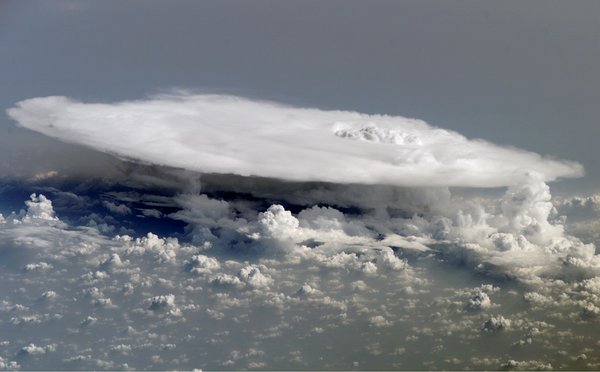
Cumulonimbus-Cloud over South America that reaches the Tropopause (Source: NASA)

CONTANGO-FIRE
Atmospheric aerosols play an important role in cloud formation and therefore influence the radiative balance of the climate system. Despite their climatic relevance, it is still not sufficiently understood from which sources these particles originate and how their properties change along the vertical structure of the atmosphere. In the upper troposphere in particular, the formation of new particles represents a key process that is especially relevant in tropical regions such as the Amazon.
Biogenic volatile organic compounds can be transported from the lower atmosphere to high altitudes by deep convective cloud systems. There, they undergo oxidation, which reduces their volatility and promotes the formation of new particles, particularly under conditions where the concentration of pre-existing aerosol particles is low. At the same time, processes in the lower stratosphere may also contribute to the aerosol population of the upper troposphere, for example as a result of volcanic emissions or through particularly strong convection that transports air masses beyond the tropopause.
As these newly formed particles grow to sufficiently large diameters, they can act as cloud condensation nuclei and thereby influence both the microphysical properties of clouds and their climatic effects. At the same time, substantial knowledge gaps remain. These include, for example, the influence of anthropogenic land-use changes such as deforestation on particle formation, chemical processes in regions characterized by strong exchange between the stratosphere and the troposphere, and the role of aerosols that are transported over long distances from marine regions.
The CONTANGO-Fire project addresses these questions within the framework of a research aircraft campaign planned for early 2028 in Argentina, which forms part of the HALO missions for atmospheric research. During the flights, aerosol size distributions in the range from 2 nm to 2.5 µm and concentrations of cloud condensation nuclei will be measured. In addition, aerosol samples collected during the campaign will be analyzed at the single-particle level in order to identify different sources and to investigate particle ageing and mixing processes in greater detail. The resulting measurements will help to better quantify the contributions of different aerosol sources to the global budget of cloud condensation nuclei and to improve the understanding of their role in cloud processes and the climate system.
Cumulonimbus-Cloud over South America that reaches the Tropopause (Source: NASA)