-
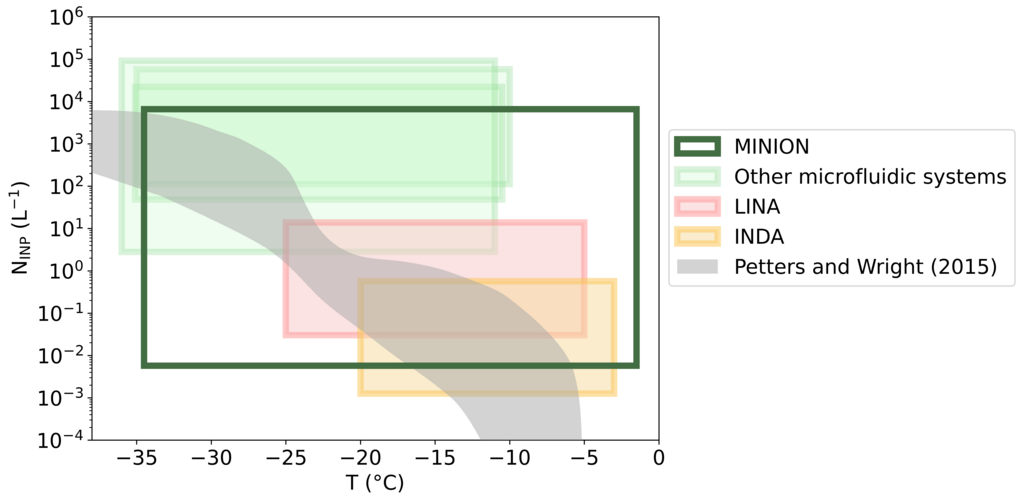
Fig. 1: MINION’s measurement range (dark green) with respect to temperature (T) and INP number concentration (NINP). The grey-shaded area depicts typical INP number concentrations in mid-latitudes. The measurement ranges of other microfluidic systems are shown in light green. The measurement ranges of the two non-microfluidic TROPOS freezing arrays LINA and INDA are shown in red and yellow, respectively.
-
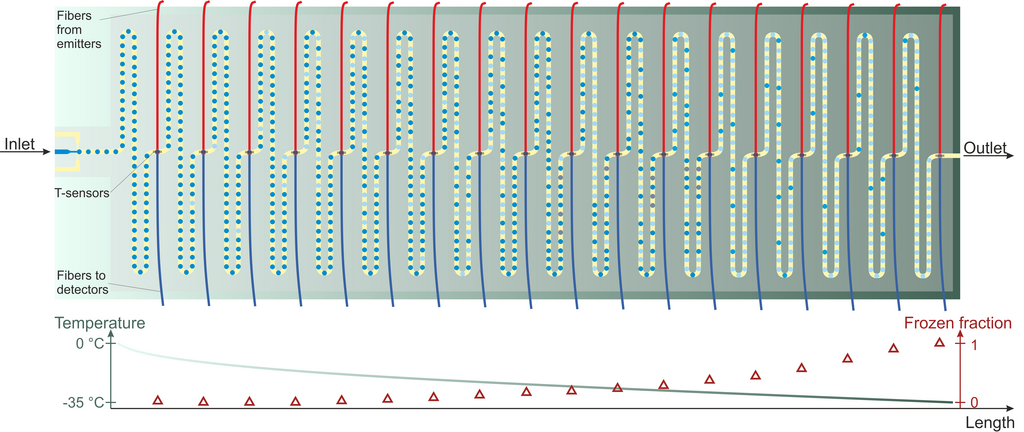
Fig. 2: Schematic of the MINION setup. Droplets stream from left to right through the meandering channel while the temperature decreases. The frozen fraction is measured at specific locations via fibers connected to the optical measurement modules.
MINION - Microfluidic device for Ice Nucleation analysis In cONtinuous flow
The project MINION (Microfluidic device for Ice Nucleation analysis In cONtinuous flow) is about the development of a novel instrument for measurements of atmospheric ice nucleating particle (INP) concentrations. INPs are a subset of atmospheric aerosol particles that catalyze primary ice formation in clouds and hence can influence their properties significantly. Measurements of INP concentration, i.e., the number of INPs active per volume of air at a given temperature, are experimentally challenging due to large atmospheric variability of ~10 orders of magnitude. Due to this, there is a wide range of different instruments available to determine INP concentrations, each covering a specific concentration and temperature range according to the measurement principle. None of the currently available instruments detect both very rare high-temperature INPs (> -10 °C) and more common low-temperature INPs (< -25 °C). One way to extend the measurable concentration and temperature range is to study very large numbers of droplets in the nanoliter volume range. These can be generated in an oil matrix using microfluidic droplet generators and subsequently be cooled down until freezing. Especially promising are applications in which droplets are continuously generated and passed over a cooled surface in a microfluidic channel. In combination with a suitable aerosol particle or cloud droplet sampler this would allow for quasi-online measurements of the INP concentration over a wide temperature range in the future. The new MINION system is characterized by a novel form of optical phase state detection, which replaces the time-consuming and often error-prone evaluation of camera images of previously developed devices and promises fast analysis of tens of thousands of droplets. This optical method can be easily and inexpensively multiplied, so that high-resolution measurements of both high- and low-temperature INPs will be possible. Besides the development of MINION, the project focuses on a comprehensive characterization and measurements of atmospheric INP concentrations using filter samples from a wide range of geographic origins. The project, funded by the German Research Foundation (DFG, Deutsche Forschungsgemeinschaft) is conducted in cooperation with the Center for Micro and Nano Technologies of the University of Technology Chemnitz.