
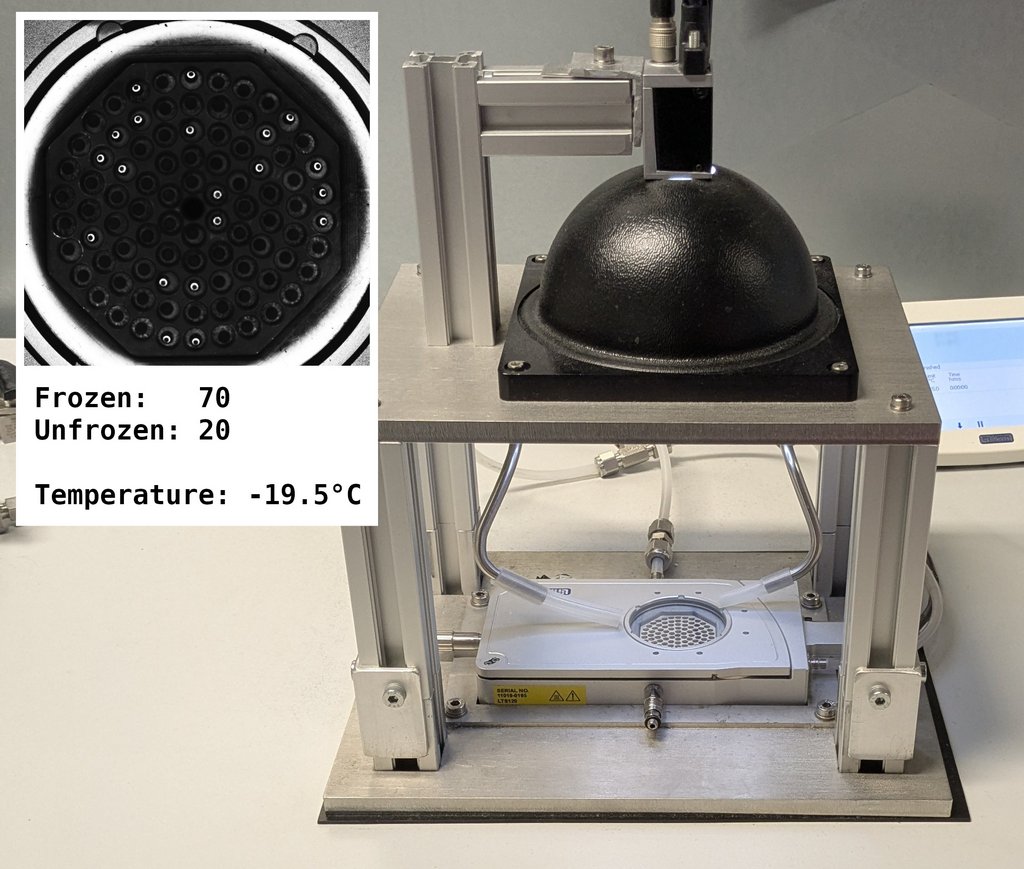
LINA uses a Peltier-cooled plate onto which a hydrophobic glass plate is placed. An aluminum spacer with 90 compartments sits on top, and 1 µL droplets of the sample suspension are pipetted into each well. The aluminum spacer is then covered with a second glass slide to seal each compatment and prevent the evaporation of the droplets. The array is cooled at 1 K/min inside a dry-air-flushed housing, and a camera captures images at the desired frequency (the default setting correponds to a 0.1 K temperature resolution). Frozen droplets are identified automatically by their change in light reflectance, yielding a freezing spectrum as a function of temperature. The setup follows the design of Budke & Koop (2015). The number of of frozen droplets at a specific temperature can be converted to an INP concentration following Vali (1971).
Off-line INP measurements
Pure water droplets freeze spontaneously only below about −38°C. At warmer temperatures, the range relevant for most atmospheric clouds, ice formation requires the help of ice nucleating particles (INP), which act as catalysts lowering the energy barrier for ice nucleation.
Atmospheric INP concentrations are very low (~1 m⁻³ to ~100 L⁻¹), making their detection challenging. At TROPOS, we use two complementary off-line techniques to measure them. Both work with suspensions of materials made in the laboratory, or with washing water of aerosol filter samples collected from the ambient air. Studies on INP conducted by TROPOS scientists in the lab or in the field are linked here.
LINA (Leipzig Ice Nucleation Array)
INDA (Ice Nucleation Droplet Array)
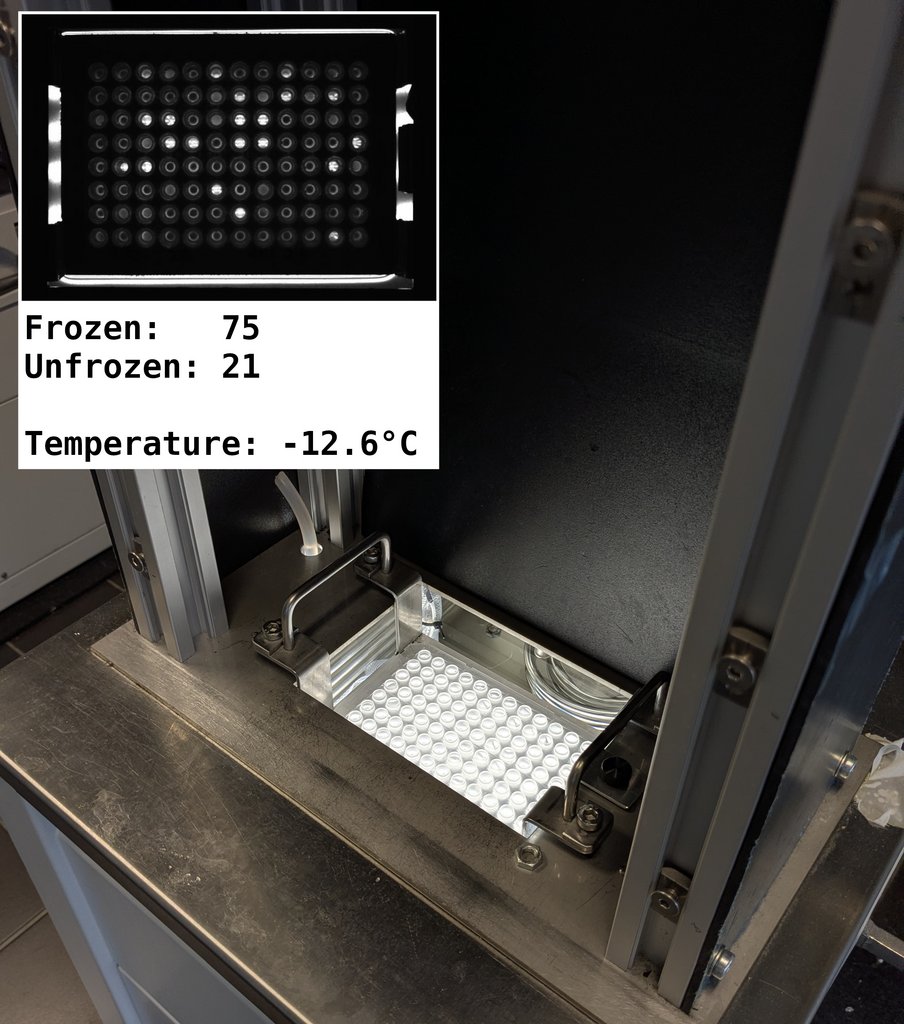
INDA uses standard 96-well PCR plates filled with 50 µL of sample per well. For quartz fiber filter samples, a 1 mm filter punch is immersed directly in pure water in each well. The sealed tray is placed in a bath thermostat and cooled at ~1 K/min, while a camera records the freezing state of each droplet every 0.1 K. As with LINA, frozen and unfrozen droplets are distinguished visually and INP concentration are determined following Vali (1971).The approach is based on Conen et al. (2012), with PCR-tray usage following Hill et al. (2014).
The usage of PCR plates also allows for the heat treatment of the samples. The sealed PCR plates are heated to the desired temperature and held at that temperature for a certain amount of time (default: 90°C for at least 30 minutes). Due to the heat treatment proteinaceous INP are destroyed. The fraction of these heat-labile INP is commonly used as a proxy for the amount of biological INPs in a sample.
Contact
Dr. Heike Wex
Scientific staff