
Leibniz Science Campus "Smoke and Bioaerosols in climate change" (BioSmoke)
The Leibniz ScienceCampus Smoke and Bioaerosols in Climate Change (LSC BioSmoke) was established to investigate the complex interactions between wildfires, aerosols, and climate change. Under the leadership of Dr. Ina Tegen, the research alliance brings together the expertise of leading institutions: Leipzig University contributes its strengths in atmospheric and biodiversity research, TROPOS investigates aerosols, clouds, and atmospheric processes, the German Biomass Research Centre (DBFZ) provides analyses of biomass combustion, and the Helmholtz Centre for Environmental Research (UFZ) complements this with insights into water and energy cycles.
Interactions between different components of the Earth system—such as those between the biosphere and the atmosphere—are still insufficiently understood, particularly in the context of accelerating climate change. Droughts and land-use changes resulting from increasing climate extremes raise the risk of vegetation fires. These fires release large amounts of smoke particles and gases, which affect air quality, the Earth’s radiation balance, and vegetation patterns. In addition, wildfires and the associated changes in vegetation influence the emissions of biological primary aerosol particles (PBAP). Due to their specific ice-nucleating properties, these particles can affect cloud formation, ice processes in clouds, and precipitation formation. A better understanding of the links between biodiversity, vegetation type, emissions of smoke and PBAP, and their atmospheric distribution and processing is therefore crucial for assessing impacts and possible future developments.
To address these multifaceted processes within the interconnected system of atmosphere, climate, and vegetation, LSC BioSmoke brings together different scientific disciplines. The campus combines outstanding expertise in (i) atmospheric and biodiversity research at Leipzig University, (ii) aerosols, clouds, and atmospheric processes at TROPOS, and (iii) biomass combustion analysis at DBFZ. The overarching goal is to better understand the controlling mechanisms and impacts of aerosol particle emissions from vegetation.
Within the BioSmoke project, the AMP department will comprehensively investigate emission processes under controlled field conditions and analyze the atmospheric properties of smoke particles.
Vegetation characteristics also play an important role in shaping fire behavior and the resulting emissions. Functional traits of plants, including leaf chemistry, water content, and structural properties of vegetation communities, influence fuel properties and the completeness of biomass combustion. Differences in vegetation structure and composition can therefore lead to substantial variation in the amount and composition of gases, aerosols, and bioaerosols released during fires.
To better understand these relationships across landscapes, the project also makes use of remote sensing approaches that provide information on vegetation structure, biomass, and fuel distribution. Techniques such as hyperspectral observations, LiDAR measurements, and satellite data are combined with machine learning methods to map vegetation traits and fuel characteristics. These data help to quantify biomass consumption during fires and provide important information for interpreting the composition and atmospheric effects of wildfire smoke.
LSC BioSmoke employs a combination of modern methods, including laboratory studies on the combustion of different types of biomass, field measurements and modeling of aerosol particle distribution and aging, and remote sensing using satellite-based and ground-based observations. The infrastructure used includes, among others, the ACD atmospheric chamber, the PollyNet lidar network, the Melpitz research station, and the research aircraft HALO, which has already conducted global measurement campaigns on wildfire smoke plumes.
A highlight of the project will be the planned field experiment in summer 2025 in Spain. In cooperation with the University of Castilla–La Mancha, vegetation fires will be conducted under controlled conditions and investigated in detail.
In addition to fostering interdisciplinary networking and strengthening the scientific profile of the region, LSC BioSmoke aims to make societally relevant contributions—particularly by improving the understanding of the interplay between vegetation, aerosols, and climate change. The ScienceCampus is one of seven Leibniz ScienceCampi in Germany. These initiatives specifically promote collaboration between universities and Leibniz institutes and provide a platform for interdisciplinary top-level research with regional anchoring and global visibility.
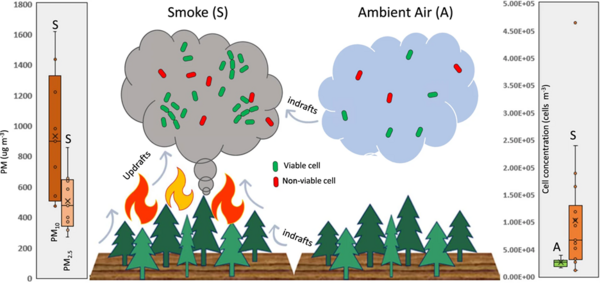
Wildland fire smoke alters the composition, diversity, and potential atmospheric function of microbial life in the aerobiome. Adapted from Kobziar et al., 2022.