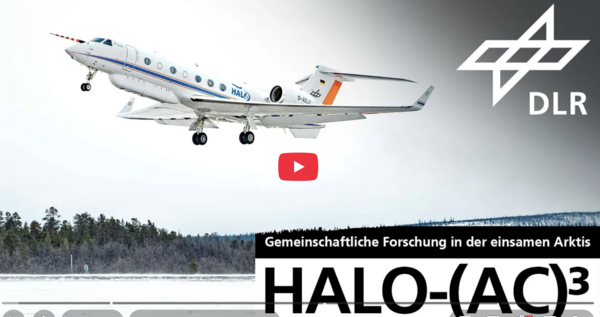
HALO-(AC)3. Video: DLR

In spring 2022, the large-scale HALO-(AC)³ research campaign took place in the Arctic, based in Kiruna in northern Sweden and Ny-Ålesund on Spitsbergen. More than 100 scientists, three research aircraft, a balloon and ground-based measuring stations were deployed to investigate the Arctic amplification – the increasingly rapid warming of the Arctic – in the context of climate change. The research teams focused in particular on northward-flowing warm air intrusions into the Arctic and southward-flowing cold air outbreaks. The extensive research campaign was led by the University of Leipzig and involved the DLR Institute of Atmospheric Physics, the Alfred Wegener Institute – Helmholtz Centre for Polar and Marine Research (AWI), the Leibniz Institute for Tropospheric Research (TROPOS), the Max Planck Institutes for Meteorology and Chemistry, as well as Ludwig Maximilian University of Munich and the universities of Cologne, Bremen, Hamburg and Mainz. International partners from 12 countries contributed to the project. The HALO research aircraft is operated by the DLR Flight Experiments facility. The AWI provided the Polar 5 and 6 research aircraft.
TROPOS participated with balloon measurements and measurements on Polar 6 in Spitsbergen.In the film about the project, the scientists discuss the challenge of gaining a better understanding of change in the Arctic, the skill required to fly three research aircraft in extreme conditions whilst optimally coordinating their positions and sensor systems, and the good fortune of being able to collect a dataset on events in the Arctic atmosphere. The findings will significantly advance both short-term weather forecasts and long-term climate models.
Film by DLR:
https://www.youtube.com/watch?v=7AraR1s0We0
HALO-(AC)3. Video: DLR