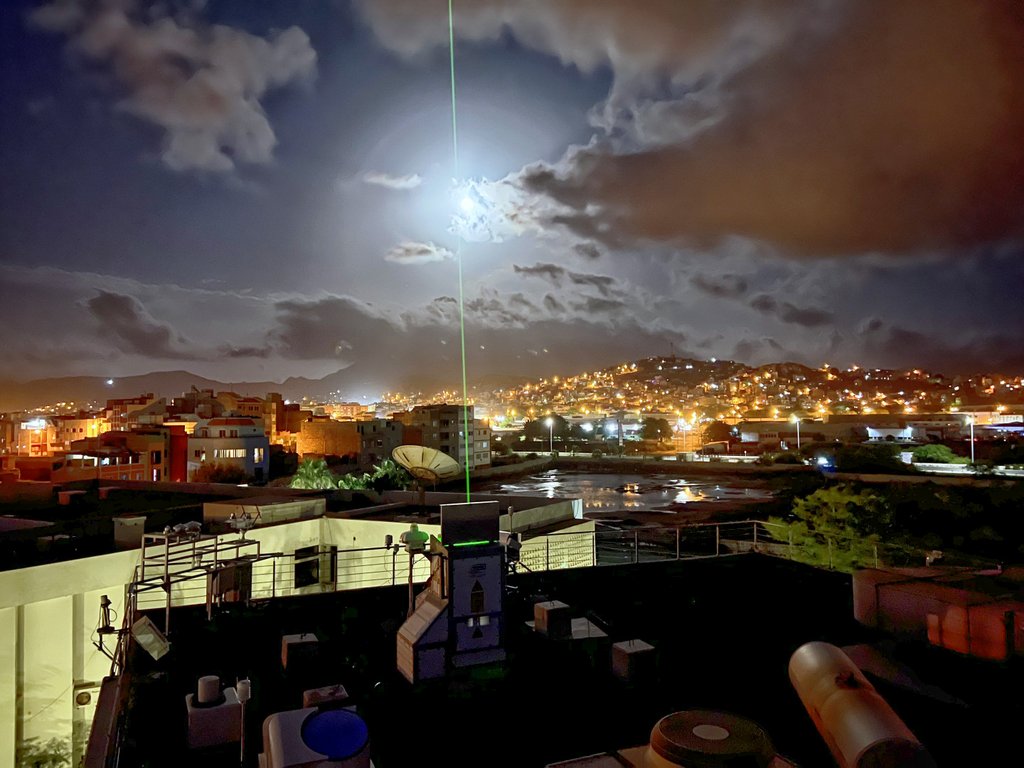
Five years of aerosol remote sensing in Mindelo – a milestone in atmospheric research in the Atlantic
Leipzig,
24.06.2026
– AS/RE/TA
New findings on Saharan dust over the Atlantic and the Canary Islands’ volcanoes
Mindelo (São Vicente). For five years now, a distinctive green laser beam has been shining at night up to 30 km above the harbour of the island’s capital. It forms part of a high-energy lidar with which the Leibniz Institute for Atmospheric Research (TROPOS) operates continuous aerosol and cloud measurements at the Ocean Science Centre Mindelo (OSCM).
The lidar is part of PollyNET, a global network of fixed and mobile lidar systems coordinated by the Leibniz Institute for Tropospheric Research (TROPOS). This network enables the detection of airborne particles (aerosols) – such as desert dust, forest fire smoke, industrial pollution or even sea salt – as well as their trajectories across our planet. The remote sensing station in Mindelo complements the dust samples that have been collected of the island of São Vicente for almost 30 years in Calhau on the north-east coast.
To mark the Lidar’s anniversary, the researchers involved have taken stock of the first few years. The focus over the past five years has been on the remote sensing of aerosols, in particular the study of the vertical structure of Saharan dust, its influence on cloud formation in the region, as well as the temporal variability of aerosol concentrations and the optical properties of the atmosphere. The station in Mindelo has thus become an important reference point for atmospheric observations in the tropical Atlantic.
The measurement station was set up in stages: since 2021, aerosol remote sensing using lidar systems has been in continuous operation, whilst instruments for cloud remote sensing were added later, primarily to better investigate aerosol–cloud interactions and the associated precipitation formation. In addition, a radiation measurement station has been in operation since 2024 to determine the influence of atmospheric conditions on the radiation balance at ground level.
A first, notable highlight of the measurements was the volcanic eruption of Cumbre Vieja on La Palma in September 2021. Aerosol particles of volcanic origin were detected by the lidar over Mindelo. The event underscored the capabilities of the remote sensing systems under exceptional atmospheric conditions.
The establishment and expansion of the measuring station were accompanied by a total of three international measurement campaigns: two campaigns named ASKOS (2021, 2022), during which measurement data were collected for comparison and calibration with the AEOLUS space lidar, and ORCESTRA/CLARINET (2024), which investigated tropical weather systems in the Atlantic between West Africa and the Caribbean. These campaigns have significantly complemented the on-site measurements and contributed to embedding the observations within a broader understanding of the processes involved. The TROPOS station received special recognition with a visit from the President of the Republic of Cabo Verde, José Maria Neves, and the Federal President of Germany, Frank-Walter Steinmeier, on 4 October 2023. On that day, the complete TROPOS suite of instruments for remote sensing and radiation measurement was put into operation.
Long-term measurements using the lidar clearly reveal pronounced seasonal Saharan dust events, strong vertical stratification of the aerosols, and high variability in dust intensity over the course of the year. At the same time, outside the dust season, stable marine salt particles occur, which characterise the natural background signal of the aerosols in the region.
To carry out these measurements on a long-term basis, scientific and technical staff from TROPOS visit Mindelo at least twice a year to carry out major maintenance work. The daily minor tasks are handled by staff from the OSCM and IMAR (IMar – Instituto do Mar). “We would like to express our sincere thanks to the residents and friends of Mindelo, the staff at OSCM and IMAR, and also the residents of the neighbourhood around the OSCM for their help and acceptance of our work,” says Prof. Andreas Macke from TROPOS. “We would also like to thank our colleagues at the GEOMAR Research Centre, without whose ongoing logistical support at the OSCM the construction and operation of the TROPOS station would not have been possible, and of course the INMG for its continued logistical support.”
The Cape Verde Atmospheric Observatory (CVAO) is now one of the long-term atmospheric observation sites worldwide that are essential for monitoring climate change. The measurements form part of the European research infrastructure ACTRIS and now provide a vital basis for understanding the atmosphere over the tropical Atlantic. Through OSCM and CVAO, the Helmholtz Centre for Ocean Research (GEOMAR) and TROPOS, together with partners such as the Instituto do Mar (IMar) and the Instituto Nacional de Meteorologia e Geofísica (INMG) of the Republic of Cape Verde, are investigating changes in the ocean and atmosphere of the tropical Atlantic off the coast of West Africa.
Ce communiqué en portugais (CV): https://www.tropos.de/fileadmin/user_upload/Aktuelles/News/Bilder/Bilder_2026/2026_Science-Blog/260628_Mindelo-Lidar-5Jahre_PT-CV.pdf
Contacts:
Dr Annett Skupin
Research Associate, Department of Remote Sensing of Atmospheric Processes, Leibniz Institute for Tropospheric Research (TROPOS), Leipzig
Tel. +49 341 2717-7081
https://www.tropos.de/institut/ueber-uns/mitarbeitende/annett-skupin
Dr Ronny Engelmann,
Research Associate, Department of Remote Sensing of Atmospheric Processes, Leibniz Institute for Tropospheric Research (TROPOS), Leipzig
Tel. +49 341 2717-7315
https://www.tropos.de/institut/ueber-uns/mitarbeitende/ronny-engelmann
and
Prof. Dr Andreas Macke,
Director and Head of the Department of Remote Sensing of Atmospheric Processes, Leibniz Institute for Tropospheric Research (TROPOS), Leipzig, and the University of Leipzig, Germany
Tel. +49-341-2717-7060
https://www.tropos.de/institut/ueber-uns/mitarbeitende/andreas-macke
or
Tilo Arnhold
Public Relations, TROPOS
Tel. +49-341-2717-7189
http://www.tropos.de/aktuelles/pressemitteilungen/
Links:
Website of the Cape Verde Atmospheric Observatory at TROPOS: https://www.tropos.de/en/research/projects-infrastructures-technology/coordinated-observations-and-networks/cvao-cape-verde-atmospheric-observatory
PollyNET website (TROPOS’s global lidar measurements): http://polly.tropos.de
Current measurement data from the Mindelo station as part of ACTRIS: https://cloudnet.fmi.fi/site/mindelo
Recent publication:
Baars, H., Haarig, M., König, L., Floutsi, A. A., Basharova, E., Hofer, J., Gebauer, H., Engelmann, R., Althausen, D., Skupin, A., Gast, B., Fritzsch, F., Ohneiser, K., Jimenez, C., Gaudek, T., Radenz, M., Buholdt, H., Heese, B., Klamt, A., Seifert, P., Donovan, D. P., van Zadelhoff, G.-J., Abdullaev, S. F., Khalifaeva, S. K., Nozirov, D. F., and Wandinger, U.: Validation of EarthCARE/ATLID aerosol profiling products with ground-based PollyNET lidars – case studies, Atmos. Meas. Tech., 19, 3831–3864, https://doi.org/10.5194/amt-19-3831-2026 , 2026.
Key publications from the last 5 years:
Gebauer, H., Floutsi, A. A., Haarig, M., Radenz, M., Engelmann, R., Althausen, D., Skupin, A., Ansmann, A., Zenk, C., and Baars, H.: Tropospheric sulphate from Cumbre Vieja (La Palma) observed over Cabo Verde contrasted with background conditions: a lidar case study of aerosol extinction, backscatter, depolarisation and lidar ratio profiles at 355, 532 and 1064 nm, Atmos. Chem. Phys., 24, 5047–5067, https://doi.org/10.5194/acp-24-5047-2024, 2024.
Gebauer, H., Floutsi, A. A., Hofer, J., Haarig, M., Skupin, A., Engelmann, R., Jimenez, C., Wagner, R., and Baars, H.: Characterisation of the annual cycle of atmospheric aerosol over Mindelo, Cabo Verde, by means of continuous multiwavelength lidar observations, Atmos. Chem. Phys., 26, 3439–3465, https://doi.org/10.5194/acp-26-3439-2026 , 2026.
The Leibniz Institute for Tropospheric Research (TROPOS) is a member of the Leibniz Association, which brings together 96 independent research institutions. Their fields of research range from the natural sciences, engineering and environmental sciences, through the economic, spatial and social sciences, to the humanities. Leibniz Institutes are dedicated to addressing issues of social, economic and ecological relevance.
They conduct knowledge- and application-oriented research, including within the interdisciplinary Leibniz research networks; they operate or maintain scientific infrastructure and offer research-based services. The Leibniz Association places a strong emphasis on knowledge transfer, particularly through the Leibniz research museums. It advises and informs policymakers, the scientific community, industry and the general public.
Leibniz institutions maintain close cooperation with universities – including through the Leibniz Science Campuses – as well as with industry and other partners both in Germany and abroad. They are subject to a transparent and independent peer-review process. Owing to their national significance, the federal and state governments jointly fund the institutes of the Leibniz Association. The Leibniz Institutes employ around 21,400 people, including 12,170 researchers.
The total funding amounts to 2.3 billion euros. They are jointly funded by the federal and state governments. The core funding for the Leibniz Institute for Tropospheric Research (TROPOS) is provided by the Federal Ministry of Research, Technology and Space (BMFTR) and the Saxon State Ministry of Science and the Arts (SMWK). The institute is co-funded from tax revenue on the basis of the budget approved by the Saxon State Parliament.
http://www.leibniz-gemeinschaft.de
https://www.bmbf.de/
https://www.smwk.sachsen.de/