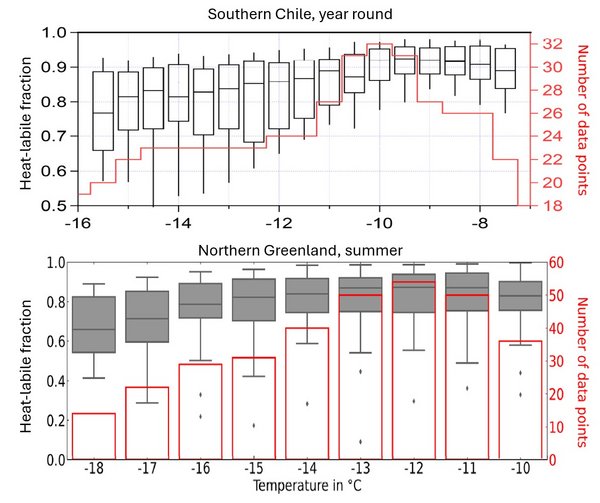
Fraction of heat-labile INPs in Southern Chile (upper panel) and in summer-time in Northern Greenland.

Atmospheric biogenic ice-nucleating particles
In several long-term measurement deployments, concentrations of ice-nucleating particles (INPs) were determined in Southern Chile (Gong et al., 2022), Northern Greenland (Sze et al., 2023) and Antarctica (Wex et al., 2025), using our off-line INP measurement devices. For all samples, also fractions of heat-labile INPs were determined (heated at 90°C for 1h). Heat-lability is generally connected to INPs of biogenic origin.
A large fraction of INPs across all examined temperatures was found to be heat-labile in Southern Chile and Northern Greenland (see figure below). This holds year-round for Southern Chile. Heat-labile fractions in Northern Greenland were particularly high for the summer time, but even in winter, they can exceed 50%. In Antarctica, INP concentrations were generally low and no clear signal of heat-labile INPs was found. This suggests that Antarctica lacks INP sources in general, and such from the biosphere in particular, which exists elsewhere, even in the Arctic.
Additionally, in a short-term deployment, INP concentrations were derived in parallel at 3 different locations, being ~ 700 km apart. These locations were Melpitz, Munich (both in Germany) and Eriswil (Switzerland), with a distance of ~ 440 km between the first two and 250 km between the latter two. Due to a prevailing high pressure system over Europe at the end of February 2024, these locations were roughly in the same airmass for 3.5 days. Atmospheric INP concentrations during these days were very similar at the three stations, the long distances between them and the different landscapes around them notwithstanding. All INPs that were ice active above -10°C were found to be heat-labile, hinting at the presence of biological INPs (Ohneiser et al., 2026).
Fraction of heat-labile INPs in Southern Chile (upper panel) and in summer-time in Northern Greenland.
Further reading
Gong, X., M. Radenz, H. Wex, P. Seifert, F. Ataei, S. Henning, H. Baars, B. Barja, A. Ansmann, and F. Stratmann (2022), Significant continental source of ice-nucleating particles at the tip of Chile’s southernmost Patagonia region, Atmos. Chem. Phys., 22, 10505–10525, doi:10.5194/acp-22-10505-2022.
Ohneiser, K., et al. (2026), Ice-nucleating particle depletion in the wintertime boundary layer in the pre-Alpine region during stratus cloud conditions, Atmos. Chem. Phys., 26, 3223–3236, doi:https://doi.org/10.5194/acp-26-3223-2026.
Sze, K. C. H., H. Wex, M. Hartmann, H. Skov, A. Massling, D. Villanueva, and F. Stratmann (2023), Ice-nucleating particles in northern Greenland: Annual cycles, biological contribution and parameterizations, Atmos. Chem. Phys., 23, 4741–4761, doi:10.5194/acp-23-4741-2023.
Wex, H., O. Eckermann, Z. Juranyi, R. Weller, A. Mangold, P. Van Overmeiren, S. Zeppenfeld, M. van Pinxteren, M. Dall'Osto, and S. Henning (2025), Antarctica’s Unique Atmosphere: Really Low INP concentrations, Geophys. Res. Lett.(52), e2024GL112583, doi:10.1029/2024GL112583.